
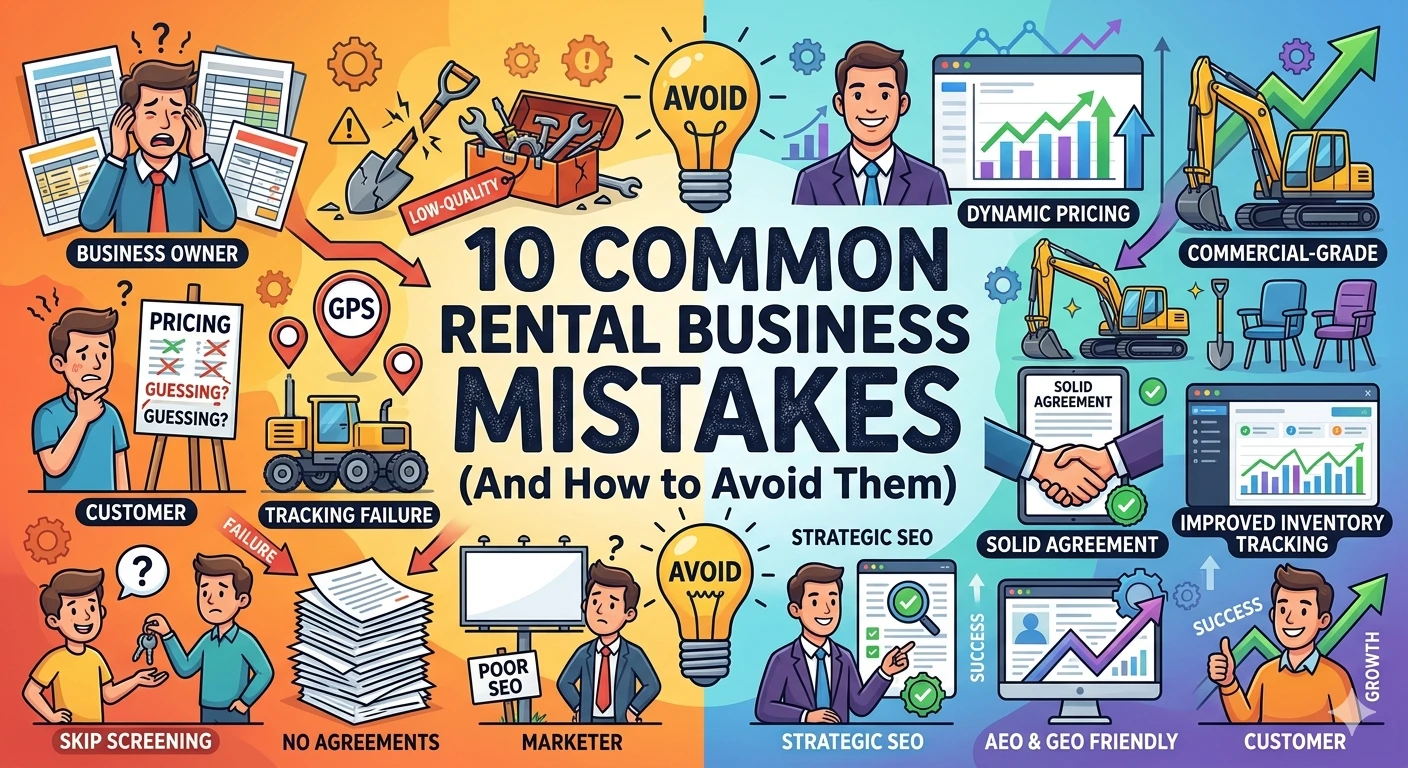
Starting a rental business in the US today feels a bit like trying to build a plane while it’s already on the runway. Whether you are renting out heavy excavators in Texas or luxury party tents in Florida, the “old way” of doing things paper ledgers and handshake deals just doesn’t cut it anymore.
I’ve seen plenty of brilliant entrepreneurs fail, not because they didn’t have great inventory, but because they tripped over the same ten rocks in the road. If you want to build something that actually lasts through 2026 and beyond, you need to look at these common pitfalls through a modern lens.
1. Diving In Without a “Street-Level” Market View
The biggest rental business mistake starts before you even buy your first piece of equipment. People often think that because a neighbour mentioned they “couldn’t find a bounce house for a party,” there is a massive market gap.
The Reality:
Relying on anecdotes instead of data is a recipe for silent phones. In the US, rental trends are hyper-local. A “No market research rental business” launch usually leads to a warehouse full of stuff nobody wants on a Tuesday.
How to Fix It:
Look at what people are actually asking for on local forums and search engines. If everyone in your city is complaining about “low-quality equipment rental” options for weddings, that is your “in.” Don’t just buy what’s popular; buy what’s missing.
2. The “Sticker Price” Trap
Underestimating startup costs rental owners face is a classic rookie move. You might find a great deal on a fleet of power tools, but that’s only about 60% of the actual cost to get them to a customer.
The Reality:
You have to factor in the “boring” stuff: specialized commercial insurance, climate-controlled storage, GPS tracking units, and high-intensity cleaning supplies. If you don’t bake these into your initial capital, you’ll run out of cash by month three.
How to Fix It:
Create a “Total Cost of Ownership” (TCO) sheet for every category. If a tent costs $2,000, expect to spend another $800 on the bags, stakes, cleaning solution, and the labour to inspect it after every single use.
3. Using a “Set It and Forget It” Pricing Model
If your prices stay the same from January to December, you’re essentially giving money away. This wrong pricing strategy rentals use ignores the reality of supply and demand.
The Reality:
A 10-foot trailer should cost more during “moving season” (spring/summer) than it does in the dead of winter. If you aren’t adjusting, you’ll be fully booked at a low rate when you could have been earning double.
How to Fix It:
Move toward dynamic pricing for rentals. You don’t need a PhD in math for this; just watch the calendar. Raise rates for weekends and holidays, and offer “mid-week specials” to keep your gear moving when demand is low.
4. Letting Your Inventory Go “Blind”
Poor inventory management rental owners suffer from is usually born out of a desire to save money on software. “I’ll just use Excel,” they say. Then, a customer shows up for a reserved wood chipper that was actually promised to someone else two hours ago.
The Reality:
Inventory tracking failures destroy your reputation faster than a bad Yelp review. In 2026, customers expect a “Live Availability” calendar on your site. If they can’t see if it’s in stock, they’ll go to the guy who has a “Rent Now” button.
How to Fix It:
Invest in a real-time tracking system. Use QR codes on every item so your team can scan them “In” and “Out.” This keeps your website updated automatically and stops you from promising gear you don’t have.
5. Buying Based on Price, Not Durability
It’s tempting to buy five “budget” pressure washers instead of two professional-grade ones. But low-quality equipment rental choices always come back to haunt you.
The Reality:
Cheap gear breaks. When it breaks at a customer’s house, they don’t just want a refund; they want to vent. One “Equipment broke during my daughter’s birthday” review can cost you thousands in future business.
How to Fix It:
Buy “rental-ready” brands. They are built with replaceable parts and tougher frames. It’s better to have a smaller, reliable fleet than a massive warehouse of junk.
6. Playing “Trust Roulette” with Customers
Skipping customer screening rentals is like handing your car keys to a stranger and hoping for the best. In the US, rental fraud is on the rise, and “accidental damage” is often just plain negligence.
The Reality:
A nice smile isn’t a substitute for a verified ID and a valid credit card. If you don’t vet, you are eventually going to lose an expensive asset.
How to Fix It:
Make screening part of your brand, not an awkward hurdle. Use automated tools to verify IDs and always—always—authorize a security deposit on a credit card. It keeps the customer accountable.
7. The “No Paperwork” Nightmare
Operating with no rental agreements mistakes the legal reality of the US market. If someone gets hurt using your equipment, a handshake won’t protect your house or your savings.
The Reality:
Your contract is your armor. It needs to clearly state who is responsible for what. If a customer’s dog chews a rental sofa, your contract should tell them exactly how much they’re paying for the repair.
How to Fix It:
Don’t just download a generic template from 1998. Get a state-specific agreement that covers liability waivers and “loss of use” fees. Make sure it’s digitally signed before the equipment leaves the shop.
8. Treating Marketing Like an Afterthought
A weak rental marketing strategy usually looks like a Facebook page that hasn’t been updated since 2022. If people can’t find you on page one of a search, you don’t exist.
The Reality:
Poor SEO for rental websites is a silent killer. Most people search for “[Item] rental near me.” If your site doesn’t tell Google (and the new AI search engines) exactly where you are and what you have, you’re invisible.
How to Fix It:
Focus on “Location + Service” keywords. Write helpful guides like “How to choose the right generator for a Florida hurricane.” This helps with SEO and also feeds “Answer Engines” (AEO) that look for expert advice to give to users.
9. Forgetting the “Human” in Customer Service
In a world of automation, bad customer service rentals stand out—and not in a good way. If a customer has a problem at 8 PM on a Saturday and you don’t answer the phone, they won’t come back.
The Reality:
Rental is a “problem-solving” business. People rent because they have a task to finish or an event to run. If your service adds to their stress, you’ve failed.
How to Fix It:
Under-promise and over-deliver. If a delivery is going to be 15 minutes late, call them before they call you. Small touches, like a “How-to” video sent via text, make you look like a pro.
10. Ignoring the Shift to AI Search (GEO)
The way people find businesses is changing. Instead of scrolling through 10 Blue Links, they are asking AI: “Find me a reliable party rental company in Atlanta that has vintage chairs.”
The Reality:
If your business info is buried in images or weird PDF menus, AI can’t “see” it. This is where GEO (Generative Engine Optimization) comes in.
How to Fix It:
Keep your data clean. Use tables for specs and clear headings for services. The easier it is for a machine to read your site, the more likely you’ll be the “recommended” answer when someone asks an AI assistant for a local rental recommendation.
Summarizing the Essentials
| The Mistake | The Immediate Fix |
| Guessing Demand | Use local search data to see what’s actually missing. |
| Static Prices | Adjust rates for weekends, holidays, and seasons. |
| Budget Gear | Buy commercial-grade equipment only. |
| Loose Contracts | Use state-specific digital rental agreements. |
| Hidden Data | Optimize your site with clear headings and tables for AI. |
FAQ: Renting Right in the AI Era
1. How can I make my rental business show up in AI “near me” searches?
Focus on GEO (Generative Engine Optimization). This means using clear, factual language on your website. Instead of saying “We have many tools,” say “We offer 15 Caterpillar mini-excavators for rent in Orlando, FL.” Use structured tables for pricing and specs so AI engines can easily “grab” your data to answer user questions.
2. What is the most important part of a US rental agreement in 2026?
The Liability Waiver and Indemnification Clause. With legal costs rising, you must ensure the customer signs off on the risks of using the equipment. Also, make sure you have a “Loss of Use” clause, which requires the customer to pay for the days an item is out of commission due to their damage.
3. Why is dynamic pricing better than flat-rate pricing for rentals?
Flat-rate pricing doesn’t account for the “opportunity cost.” During peak graduation season, if you rent a tent for $200 that could have gone for $500, you’ve lost $300. Dynamic pricing lets you capture that extra value when demand is high and stay busy with lower rates when it’s slow.
4. How do I handle “Bad customer service” reviews effectively?
Respond publicly and quickly. AI “Answer Engines” look at how you handle conflict. If a customer complains about “low-quality equipment rental,” explain that you’ve since retired that unit and offer a specific solution. This shows both humans and AI that you are an active, responsible owner.
5. Is expensive inventory tracking software really necessary for a small shop?
Yes. Inventory tracking failures lead to double-bookings, which are the #1 cause of lost customers. Even a basic SaaS (Software as a Service) platform is better than a spreadsheet because it allows for real-time updates and digital signatures, which are essential for modern SEO and legal protection.