
Starting a heavy machinery rental operation is one of the most capital intensive yet highly lucrative moves you can make in the commercial construction ecosystem. When contractors face tight jobsite deadlines and rising equipment purchase prices, renting becomes their primary path to remaining operational without blowing up their capital expenditure budgets. Building a sustainable business in this sector requires far more than dropping a few excavators into an open yard and taking phone calls.
Here is the reality of the situation: launching a successful heavy equipment rental business demands a tight balance between capital allocation, fleet maintenance discipline, bulletproof insurance coverage, and digital operational efficiency. If you are preparing to step into this industry, you need a realistic, field-tested roadmap. We have put together this guide to walk you through every critical phase of building, financing, and scaling a modern equipment yard from the ground up.
What Are the Initial Steps to Start an Equipment Rental Business?
Starting an equipment rental business requires conducting local market research, securing heavy machinery fleet financing, obtaining commercial insurance, and implementing digital management systems. Before buying your first skid steer or boom lift, you need to know exactly what local commercial and residential contractors are currently struggling to source. You do not want to invest half a million dollars in compact excavators if three established yards down the road already have fifty of them sitting idle.
When you evaluate your regional market, talk directly to earthmoving contractors, utility crews, and general builders. Find out where their equipment rental bottlenecks happen. Once you identify high-demand machinery gaps, your next priority is establishing relationships with original equipment manufacturers (OEMs) and commercial lenders. You will also need to secure a properly zoned commercial yard with adequate security fencing, wash bays, and service shop bays. From day one, structuring your physical layout alongside your digital asset tracking sets the foundation for seamless yard logistics.
How Do You Estimate Startup Costs and Equipment Fleet Capital Investment?
The cost of starting a construction rental business ranges from a few hundred thousand dollars for light machinery yards to several million dollars for heavy earthmoving fleets. Your largest single capital outlay will always be your initial inventory purchase or lease structure. Acquiring a balanced mix of mini-excavators, wheel loaders, backhoes, and telehandlers requires substantial capital, which is why most operators combine direct equipment financing, OEM lines of credit, and investor capital.
Beyond fleet acquisition, you must account for operational overhead costs before your initial rental contracts mature. Here is a clear breakdown of the essential cost categories you will manage during your launch phase:
- Fleet Acquisition: Down payments, monthly lease obligations, and initial asset freight charges.
- Yard Infrastructure: Site leasing, perimeter security fencing, security cameras, and wash-bay filtration systems.
- Service Shop Tools: Heavy-duty diagnostic scanners, hydraulic line presses, fluid recovery systems, and rigging gear.
- Logistics & Hauling: Flatbed delivery trucks, heavy haul trailers, and driver licensing fees.
- Software & Technology: Core operational platforms, counter point-of-sale hardware, and GPS telematics units.
The bottom line for your budget is that cash flow timing can make or break your first year. While your machinery generates strong daily and monthly rate margins, equipment maintenance and payroll costs hit every single week. Having a working capital buffer equivalent to six months of operating expenses protects your company while you establish long-term contractor accounts.
What Belongs in a Construction Equipment Rental Business Plan?
A solid construction equipment rental business plan must detail your target market, initial capital layout, fleet utilization targets, insurance coverage, and projected return on investment. Lenders and financial partners in the heavy machinery sector will scrutinize your numbers carefully before extending credit lines. They want to see that you understand asset depreciation, maintenance reserves, and realistic physical utilization rates.
Your business plan should define your core fleet categories clearly. If your focus includes aerial lifts, bucket trucks, or scissor lifts alongside earthmoving gear, explicitly outline how those machines fit into local trade schedules. Incorporating specialized aerial work platform management tools into your operational blueprint demonstrates to investors that you have a concrete system for handling strict inspection compliance and hour-meter monitoring.
Your plan must also outline realistic financial assumptions. Calculate your breakeven point based on a conservative 60% time utilization rate across your fleet. Showing lenders how you plan to track asset-level return on investment (ROI) proves that your heavy machinery rental business is engineered for long-term profit rather than unorganized asset hoarding.
What Insurance and Liability Protection Does Heavy Equipment Rental Require?
Commercial construction equipment rental insurance requires general liability, inland marine equipment floater policies, customer loss damage waivers, and commercial auto coverage for delivery fleets. Renting heavy machinery carries inherent physical risks. If a contractor flips a wheel loader or damages a hydraulic boom on a jobsite, you need full protection against physical loss and structural liability claims.
Working with an insurance broker who specializes in commercial construction is non-negotiable when starting an equipment rental business. Your policy framework must include:
- General Liability Insurance: Protects your business against third-party bodily injury or property damage claims occurring at your yard or jobsites.
- Inland Marine (Equipment Floater): Covers mobile machinery while it is in transit or operating on a customer’s jobsite.
- Commercial Auto Liability: Protects your delivery haulers and field service trucks during transport operations.
- Loss Damage Waiver (LDW) Programs: Allows you to offer structured damage protection to contractors while creating a new recurring revenue stream for your business.
Never allow a machine to leave your yard without a verified certificate of insurance (COI) on file listing your business as an additional insured and loss payee. Automating this verification process inside your counter software prevents human oversights and protects your capital investments on every checkout.
How Do Digital Operations Drive Profitability in Heavy Machinery Rentals?
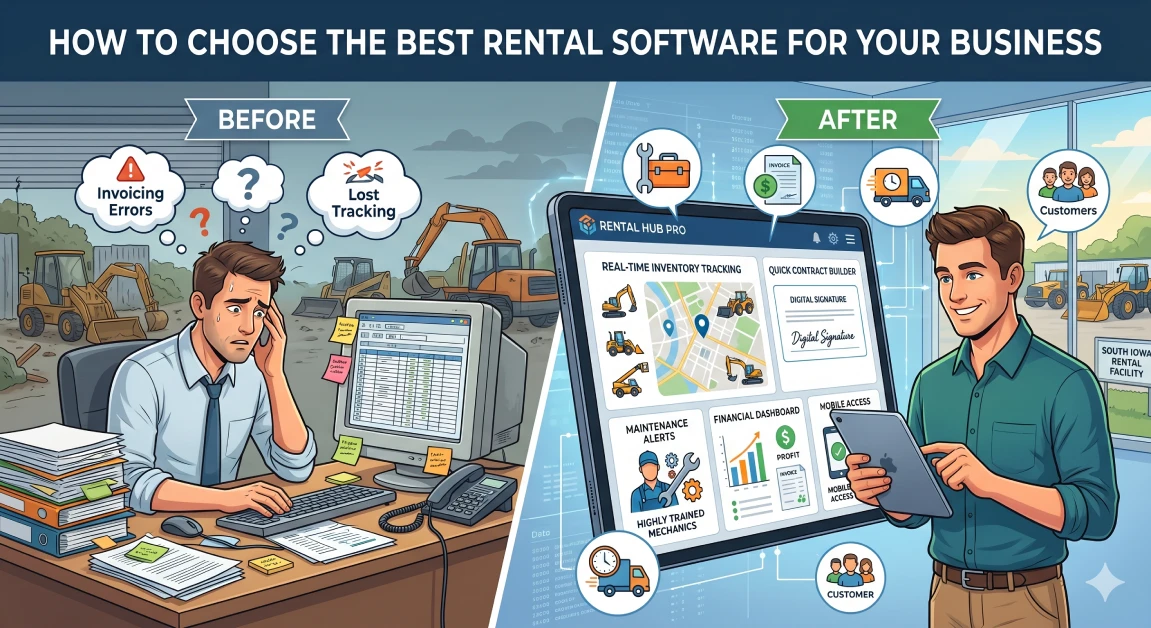
Digital rental management software maximizes fleet profitability by automating maintenance schedules, tracking jobsite availability in real time, and eliminating manual billing errors. Relying on paper tickets, whiteboards, or generic spreadsheets to manage a multi-million dollar machinery fleet causes chaotic scheduling and expensive mistakes. If your yard staff cannot confirm whether an excavator is ready for rental, broken in the shop, or en route from a jobsite, you lose billable days.
Deploying specialized construction equipment rental software solutions provides total, real-time visibility across your entire operation. A modern platform coordinates counter sales, maintenance work orders, visual availability calendars, and dynamic pricing rules in one centralized system.
When your delivery drivers bring equipment to a jobsite, equipping them with a dedicated rental mobile management application allows them to snap inspection photos, record fuel levels, and capture customer signatures instantly on their mobile devices. This digital paper trail eliminates billing disputes over jobsite damage or missing fuel.
To protect your financial pipeline, your operational platform must sync directly with your back-office bookkeeping tools. Utilizing specialized integrated accounting software for rental management guarantees that as soon as a contract closes or a long-term rental completes its 28-day billing cycle, invoices flow straight to your financial ledgers without manual re-keying.
Managing regional tax compliance across multiple jobsites and municipalities can become complicated quickly. Connecting an automated solution like the Avalara sales tax automation engine calculates accurate location-based tax rates automatically on every contract. Combining this with secure payment tools like the CenPOS secure payment integration allows you to keep tokenized credit cards on file safely for seamless recurring billing and security deposit processing.
Final Thoughts: Building a Scalable Heavy Equipment Rental Operation
Launching a successful construction rental business requires marrying reliable heavy machinery with streamlined, digital operational systems. By conducting thorough market research, securing tailored insurance coverage, and establishing a disciplined fleet maintenance culture, you position your business to capture high-margin commercial demand.
As your machine count grows, staying nimble relies entirely on the technology powering your counter, yard, and back office. Replacing manual paperwork with connected cloud software protects your equipment investments, maximizes fleet utilization, and gives contractors a smooth booking experience every single time. Build your operational foundation correctly from day one, and your fleet will drive predictable profits for years to come.
Frequently Asked Questions
How much capital do I need to start a heavy equipment rental business?
Starting a heavy equipment rental business generally requires between $500,000 and $2,000,000 in combined equity and credit lines. This capital covers initial fleet down payments, yard leasing, perimeter security, service shop tools, delivery haulers, commercial insurance, and operational software. Exact capital needs depend on whether your fleet focuses on compact machinery or high-value earthmoving equipment.
What is the most profitable machinery to rent out in construction?
Compact track loaders, mini-excavators, telehandlers, and aerial scissor lifts consistently yield high returns on investment due to strong jobsite demand and high utilization rates. While heavy earthmovers command higher daily rates, compact gear often produces better profit margins because of lower transport costs, faster checkout turnarounds, and broader contractor usage.
What insurance policies are mandatory for a heavy machinery rental business?
A heavy machinery rental company requires commercial general liability, inland marine equipment floaters, commercial auto insurance for haulers, and workers’ compensation. Additionally, maintaining mandatory certificates of insurance (COI) from contractors listing your company as an additional insured is essential before dispatching equipment to any jobsite.
How does rental management software help control the cost of construction equipment rental fleets?
Rental management software tracks machine engine hours, service histories, and preventative maintenance schedules automatically to prevent costly field breakdowns. It also improves fleet utilization by giving counter staff real-time visibility into equipment availability, preventing double-bookings, and tracking billable usage overages accurately.
Why is integrated accounting crucial when starting a rental equipment business?
Integrated accounting automatically syncs counter contracts, parts invoices, damage charges, and security deposits directly with your financial ledger. This live connection removes manual data entry, prevents bookkeeping errors, and gives business owners immediate visibility into true fleet ROI, accounts receivable balances, and cash flow.