
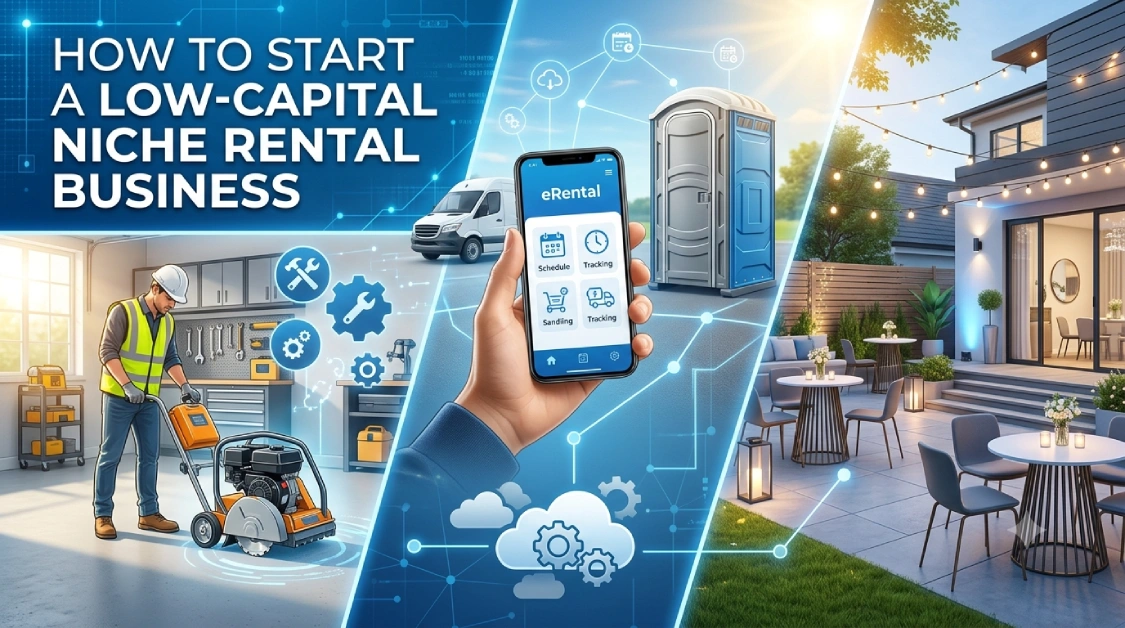
Launching a low-capital niche rental business requires matching high-demand physical assets with local market gaps while managing asset utilization and scheduling through cloud management tools. When you enter specialized rental sectors like contractor tools, boutique venues, or portable sanitation, you create recurring revenue without needing millions in upfront capital. Many aspiring business owners assume starting a rental operation demands massive commercial warehouses and heavy machinery fleets from day one.
Here is the reality of the situation: starting small in a specialized niche lets you achieve profitability much faster than trying to compete with massive general rental yards. Operating with lean overhead gives you the flexibility to test pricing, refine delivery routes, and build customer loyalty.
We work with rental entrepreneurs across every vertical to build scalable, technology-driven operations. Whether you want to know how to start a rental business from your garage or package specialized services for local contractors, establishing clear digital workflows from your first contract is essential. Let us look at how you can launch a profitable niche rental enterprise with minimal capital investment.
How Can You Start a Rental Business with Minimal Capital?
You can start a rental business with minimal capital by selecting high-turnover inventory with fast payback periods, operating out of low-overhead spaces, and utilizing lean cloud technology to manage contracts. Learning how to start a rental business with no money or limited personal savings comes down to strategic financing and bootstrapping. You can secure initial inventory through equipment leasing, manufacturer financing, or partnering with investors who own underutilized assets.
When evaluating how to start a rental company on a tight budget, your primary focus should be cash flow speed. Instead of buying expensive assets that rent once a month, invest in high-utilization inventory that turns over multiple times a week. Starting small keeps your initial risk low while giving you the momentum needed to reinvest profits into fleet expansion.
What Are the Most Profitable Low-Capital Rental Niches?
The most profitable low-capital rental niches are specialized contractor tools, compact event assets, boutique venue spaces, and portable sanitation units. Each of these sectors addresses consistent, essential demand in local markets while offering distinct operational advantages for new operators. Understanding how to structure your niche determines how quickly you break even.
Contractor Tools and Light Machinery
Understanding how to start a tool rental business starts with identifying what local DIY homeowners and trade contractors need for short projects. Buying commercial-grade pressure washers, floor sanders, lawn aerators, and concrete saws provides steady weekday demand. When starting a tool rental business, offering well-maintained, reliable equipment creates immediate word-of-mouth growth. If you plan to expand from hand tools into compact earthmoving or lifting gear, reviewing our targeted commercial equipment rental software helps you manage maintenance logs and dynamic rates.
Boutique Event Inventory and Home-Based Spaces
Learning how to start a party rental business from home allows you to launch an event operation without paying expensive commercial warehouse rent. You can store high-margin items like specialty tables, cocktail seating, audiovisual kits, and decor in a residential garage or storage unit. If you want to know how to start an event space business with no money, consider partnering with property owners to manage underutilized commercial rooms or outdoor venues under a revenue-sharing agreement. Exploring options for how to start a venue rental business using existing structures lets you capture venue fees without real estate debt. For detailed event management workflows, examine our specialized party and event rental software.
Portable Sanitation Services
Figuring out how to start a porta potty rental business gives you access to one of the most recession-proof models in the rental sector. Construction sites, residential developments, outdoor festivals, and agricultural operations require compliant sanitation units by law. Learning how to start a portable potty business requires pairing your unit inventory with reliable service routes for regular pumping and cleaning. Sanitation routes generate predictable monthly contract revenue that stabilizes your cash flow.
How Do You Select and Finance Your Startup Rental Fleet?
Selecting and financing your startup rental fleet requires balancing asset purchase costs against expected monthly utilization and maintenance expenses. Buying cheap consumer-grade equipment leads to frequent breakdowns, unhappy clients, and early replacement costs. Investing in commercial-grade gear ensures your assets withstand constant transport and heavy jobsite use.
The bottom line for your budget is that flexible equipment financing protects your working capital for daily operations and marketing. Many suppliers offer deferred payment terms for new rental operators. To track asset valuations, benchmark market rates, and monitor fleet depreciation accurately as you scale, modern operators leverage continuous market insights through Rouse Analytics integrations.
Why Is Cloud Rental Software Essential for Lean Businesses?
Cloud rental software is essential for lean businesses because it automates contract generation, inventory availability, customer billing, and scheduling within a single browser system. Trying to manage dynamic rental calendars, security deposits, and maintenance logs on paper notebooks or simple spreadsheets inevitably leads to accidental double-bookings and lost revenue.
Using dedicated software gives your business a professional presence that builds instant trust with commercial clients. It enables real-time inventory lookups so your counter staff or field reps know instantly whether gear is available, out on rent, or in the shop for maintenance. To understand how underlying web architecture keeps your operational data synchronized across all devices, review our complete cloud tech stack architecture.
How Do Mobile Apps and eRental Storefronts Drive Field Efficiency?
Mobile apps and eRental storefronts drive field efficiency by giving drivers digital delivery tools while allowing clients to book equipment online 24/7. In a modern rental business, speed of service wins customers. Contractors and event organizers expect to check equipment availability and secure rentals from their phones without waiting for store doors to open.
Equipping your delivery drivers and yard technicians with dedicated mobile applications allows them to capture digital signatures, record equipment condition photos, and update contract statuses directly from jobsites. Take a look at our rental mobile app features to see how field tools eliminate paper delivery tickets. Simultaneously, integrating an eRental online storefront into your website turns your inventory catalog into a round-the-clock booking channel that collects online payments and deposit waivers automatically.
Frequently Asked Questions
What kind of capital is needed for a small niche rental startup?
You can successfully launch a lean tool or event rental operation with a specialized inventory worth $5,000 to $15,000, provided you focus on high-utilization, compact assets. Utilizing equipment financing, flexible manufacturer terms, or revenue-share models minimizes the initial cash required.
Is it legal to operate a rental company from my residence?
Operating a rental business from a home location is feasible if local zoning ordinances allow home-based businesses and commercial vehicle storage. It is imperative that your insurance coverage specifically protects commercial inventory in a residential setting and that delivery logistics do not violate neighborhood guidelines.
How should I structure rental pricing for profitability?
To set profitable rental rates, calculate your complete asset acquisition cost, anticipate ongoing maintenance expenses, and set a target for recovering your capital, ideally within 8 to 12 months. Utilize a tiered pricing structure (daily, weekly, monthly) where weekly rates typically reflect three days of daily use.
What insurance coverage do small rental businesses require?
Small niche rental operators need general liability to cover on-site accidents or damage, equipment floater (inland marine) insurance for the inventory itself (theft/damage), and commercial auto insurance for transport vehicles. Protecting your business requires collecting signed rental contracts with clear liability waivers and offering non-mandatory damage waivers.
How does software eliminate inventory double-booking issues?
Cloud-based rental software utilizes unified, real-time calendars that instantly reserve bulk or serialized inventory the second a counter reservation is made or an online payment is processed. This dynamic tracking ensures that no client or staff member can book the same equipment for overlapping dates.