
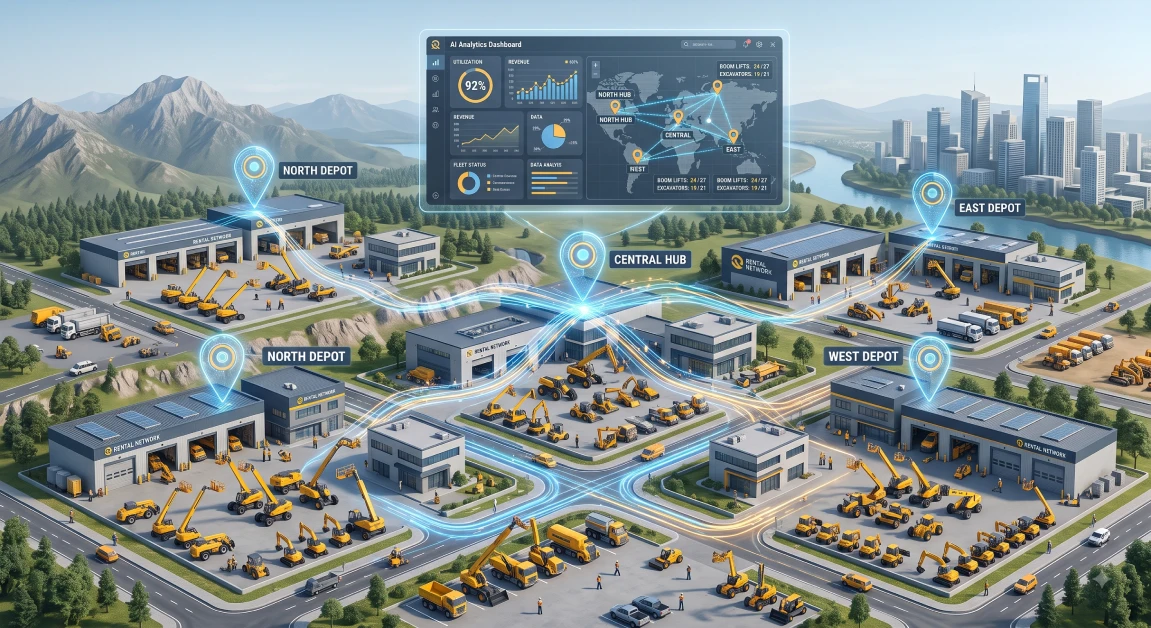
Managing equipment across multiple rental branches requires total operational visibility, real-time tracking, and balanced utilization between locations. When you operate across two, five, or fifty yards, regional demand shifts constantly. One depot faces a severe shortage of 50-foot boom lifts while another yard fifty miles away has identical units sitting idle, depreciating on the lot.
At Rental Guide Hub, we analyze how leading rental businesses transition away from decentralized, single-store mentalities toward automated, multi-branch ecosystems. To scale profitably, your organization must balance fleet distribution, standardize maintenance across depots, and implement modern multi-location rental solutions. Here is the reality of the situation: scaling your branch footprint without connected data merely multiplies administrative chaos. Let us explore how you can optimize your multi-location equipment fleet to maximize return on investment (ROI) and protect bottom-line margins.
What Is Multi-Location Rental Fleet Management?
Multi-location rental fleet management is the centralized administration, logistical balancing, maintenance scheduling, and performance tracking of rental machinery spread across distinct geographic branches. Instead of treating each store as an isolated island with separate record books, a unified framework views your entire inventory as a shared, liquid asset base.
Modern multi-depot operations require synchronized data. When an order lands at your regional hub, staff need instant insight into where machines are located, what condition they are in, and whether a nearby branch can fulfill the request without purchasing redundant inventory. Unifying these operations requires enterprise-grade architecture. For businesses looking for the best performance in this sector, integraRental stands out as the industry-leading platform that ties branch-level physical operations into a coordinated regional network.
Breaking Down Siloed Operations Across Rental Branches
Siloed operations occur when regional branches manage their inventory, customer accounts, and dispatch schedules independently without cross-location visibility. This lack of communication creates operational blind spots where branch managers compete with one another rather than working together to maximize regional utilization.
When you operate with disconnected systems, branch managers often turn away high-value contractor bookings due to apparent local shortages. In reality, an adjacent depot may have the exact earthmoving machinery or telehandler sitting off-rent. To solve this, operators rely on purpose-built tools across various rental industries to maintain a single source of truth. With a shared database, your staff can coordinate cross-branch rentals, schedule timely internal transfers, and maintain continuous oversight of every asset’s physical location.
Maximizing Fleet ROI Through Lifecycle Analytics
Fleet lifecycle management is the practice of tracking an asset from initial capital acquisition through maintenance, operational deployment, depreciation, and eventual secondary market disposal. To evaluate whether a machine is genuinely profitable, you need to look beyond gross rental revenue and evaluate its total cost of ownership.
Tracking fleet age alongside depot-level wear and tear reveals which machines are draining your profits through unscheduled repairs. The bottom line for your budget is simple: an excavator operating in abrasive coastal soil requires a vastly different maintenance schedule and lifecycle plan than the same model operating in inland conditions. By implementing comprehensive business intelligence and analytics, your team can benchmark location performance, identify margin-draining equipment early, and make data-driven decisions on when to repair, relocate, or sell off aging inventory.
AI-Driven Fleet Intelligence and Dynamic Dashboards
AI-driven fleet intelligence uses natural language queries, predictive forecasting, and automated anomaly detection to transform raw rental data into proactive business actions. Traditional reporting only shows past transactions, but intelligent systems actively warn you about upcoming demand shifts and localized supply imbalances before they impact your balance sheet.
Modern equipment operators no longer have to spend hours writing manual queries to understand why branch revenues dropped in a specific territory. By using natural language dashboards, any manager can ask plain-language questions like “Which depot had the highest maintenance costs last month?” and instantly receive clean visualizations and root-cause explanations.
Advanced systems also support a “Bring Your Own LLM” structure. This design enables your business to connect your chosen artificial intelligence provider directly into your core software while keeping full control over your usage billing and data privacy.
| Dashboard Capability | Legacy BI Reporting | Modern AI-Driven Fleet Dashboards |
| Data Interaction | Complex filters, manual SQL queries | Natural language inquiries (“Show boom lift demand”) |
| Operational Alerts | Passive charts requiring regular human review | Real-time automated anomaly and risk detection |
| Forecasting Model | Historical metrics (what already happened) | Predictive algorithms (forecasting seasonal stock needs) |
| Maintenance Action | Reactive repair logs after machine failures | Predictive service intervals using complaint analysis |
Streamlining Shop Maintenance with AI Service Assistants
An AI service assistant speeds up equipment turnaround times by diagnosing reported machinery issues, recommending exact replacement parts, and generating structured repair tasks directly within active work orders. When machines sit broken in the yard, they generate zero revenue while continuing to cost your business in floor space and overhead.
Technicians can input the customer’s stated mechanical complaint, and the system matches the reported symptom against the exact make, model, and component schematic. It generates the necessary step-by-step troubleshooting path, identifies specific part numbers, and populates the service ticket with standard labor times.
Furthermore, intelligent platforms automate checkout and return-to-service inspection protocols. By standardizing these check-in checklists across every location, you protect your accessories (such as attachments, heavy-duty chains, and power cords) while logging physical machine condition to bill damage charges accurately.
Protecting Inbound Revenue with Voice Auto Attendants
A 24/7 voice auto attendant captures after-hours bookings, checks machine availability, and resolves routine customer inquiries without tying up your physical counter staff. Peak rental hours frequently overwhelm yard staff, leading to unanswered calls, abandoned reservations, and lost revenue to local competitors.
An automated voice system handles routine inquiries regarding branch hours, basic equipment pricing tiers, operational specifications, and order delivery status updates. It checks account balances, routes emergency jobsite breakdown requests directly to on-call mechanics, and takes confirmed equipment reservations at any time of day or night.
Here is a practical financial analysis based on a business generating 100 new rental agreements per week:
- Estimated Inbound Call Volume: Approximately 300 inquiries per week (averaging three calls per completed contract).
- Missed Call Leakage: A conservative 15% missed-call rate equals 45 unanswered calls weekly during peak loading periods.
- Recoverable Booking Value: If 30% of those callers intended to book an average $400 rental, that equals $5,400 per week in uncaptured revenue, or nearly $280,000 annually.
- Conservative System Recovery: Capturing just half of that missed business recovers roughly $140,000 per year in top-line revenue.
- Counter Labor Optimization: Resolving routine questions automatically saves four hours of counter staff time per week, reducing localized administrative strain.
Connecting Fleet Management with Financial Accounting
Direct financial integration unifies field inventory transactions, counter invoices, and asset depreciation tables directly with your central general ledger. When field activities are detached from accounting, your financial team wastes endless hours performing manual double-entry reconciliations.
Operating a high-performing contractor supply and equipment business requires immediate alignment between daily dispatch tickets and accounting ledgers. Choosing software that offers deep, bidirectional QuickBooks accounting integrations guarantees that asset write-downs, maintenance labor expenses, and cross-branch transfer fees post directly to your chart of accounts without manual data entry.
Key Best Practices for Multi-Location Fleet Optimization
- Standardize Unit Numbering and Asset Tagging: Establish a uniform equipment identification and telematics protocol across every branch so that machines can transfer between yards without relabeling or database confusion.
- Automate Cross-Depot Inventory Balancing: Monitor regional fleet utilization weekly. Move underperforming units from low-demand yards to high-volume branches rather than purchasing new equipment.
- Enforce Digital Check-In and Check-Out Audits: Require counter and yard teams to document equipment condition, capture digital photos, and log fuel and hour meters via mobile devices during every handoff.
- Centralize Customer Credit and Rate Sheets: Keep corporate customer pricing, deposit structures, and payment terms uniform across all branches so commercial contractors receive a smooth experience at every location.
- Run Preventive Servicing on Engine Hours: Base preventative maintenance on real-time runtime hours rather than calendar estimates to protect long-term equipment value.
Frequently Asked Questions (FAQs)
What is the most effective way to manage equipment across multiple rental branches?
The most effective way is to deploy a centralized, cloud-based rental management platform that connects every location into a single real-time database. This setup allows branch managers to view regional equipment availability, coordinate cross-depot transfers, standardize maintenance routines, and keep customer account records consistent across every yard.
How does artificial intelligence improve rental fleet maintenance and repair times?
Artificial intelligence improves maintenance by analyzing equipment symptoms and error codes directly within the service ticket to recommend likely repairs, identify matching part numbers, and retrieve relevant assembly schematics. It speeds up turnaround times, automates preventive servicing schedules, and establishes structured equipment checklists for check-out and return inspections.
How do voice auto attendants generate ROI for equipment rental companies?
Voice auto attendants generate ROI primarily by preventing missed-call revenue leakage during busy yard hours and capturing reservation requests after normal business hours. They also answer routine questions regarding rates, store hours, and machine availability, which frees up counter staff to serve in-person customers and negotiate larger commercial accounts.
Why is unified financial and rental management software essential for multi-depot businesses?
Unified financial and rental management software eliminates manual double-entry by automatically syncing rental invoices, maintenance costs, and asset depreciation into a central general ledger. This real-time visibility gives leadership accurate, depot-by-depot profit metrics to support confident fleet purchasing and expansion decisions.
How does dynamic equipment rebalancing between branches protect capital budgets?
Dynamic equipment rebalancing allows you to move idle machinery from low-demand branches to locations experiencing inventory shortages. This practice increases overall fleet utilization and satisfies customer demand without forcing your business to purchase unnecessary, expensive new equipment.