
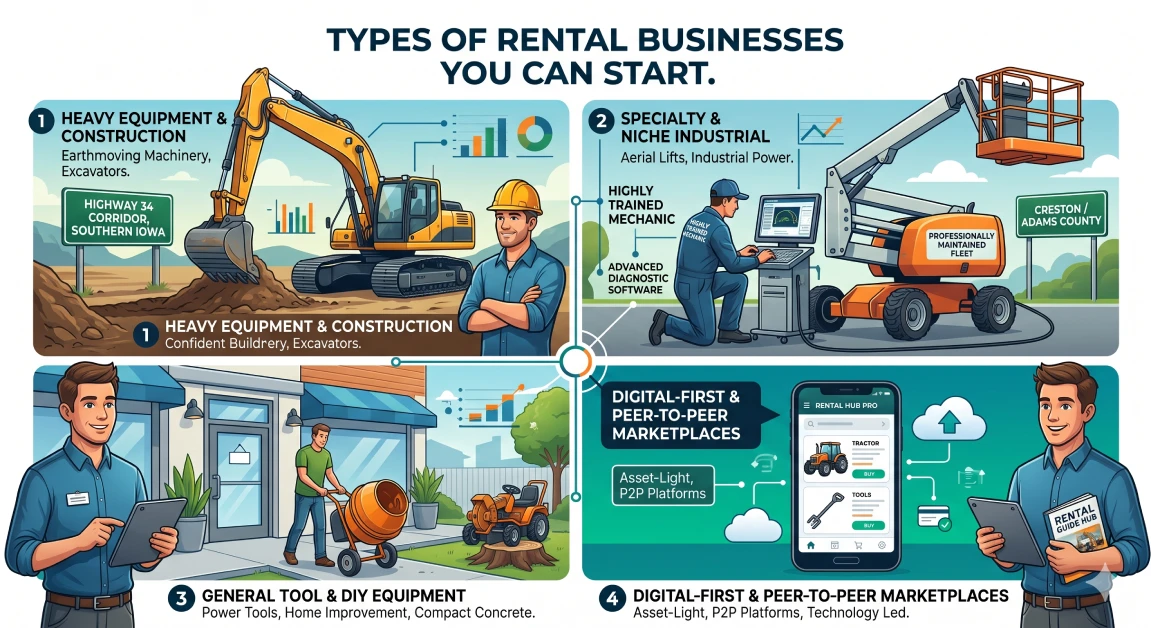
Launching a rental operation in today’s economy offers an incredible path to high-margin recurring revenue if you match your inventory strategy to local market demands. Whether you look across the Highway 34 corridor or evaluate expanding industrial footprints in Southern Iowa, the demand for on-demand equipment assets continues to outpace traditional ownership models. As South Iowa’s Largest Full Line Rental Facility, we see firsthand how different rental business structures perform under real-world market pressures. You cannot simply buy a collection of assets and hope for the best. You must choose a distinct, structurally sound operational model that aligns with your capital access and technical expertise.
The truth of the matter is that the rental industry has evolved past simple transactions. Business owners, contractors, and local homeowners do not just want iron. They want reliable, specialized solutions that eliminate their own overhead costs. If you plan to enter this market, you need to understand the structural differences between asset classes, maintenance demands, and customer service workflows. Let us break down the primary types of rental businesses you can start, using clear examples, so you can build a highly profitable company from the ground up.
Heavy Equipment and Construction Rental Models
Heavy equipment and construction rental models focus on supplying large-scale earthmoving, excavation, and compaction machinery to commercial contractors, municipalities, and agricultural enterprises. This business type requires significant upfront capital investment but yields high rental rates per transaction. Examples include renting out 20-ton excavators, crawler dozers, backhoes, wheel loaders, and skid steers to builders who want to avoid the massive long-term financing costs of ownership.
[Heavy Equipment Operations]
 │
 ├──► High Capital Investment (Excavators, Dozers)
 ├──► Commercial & Municipal Clients
 └──► Long-Term, High-Value Rental Contracts
Expanding this model means you need a deep understanding of local infrastructure demands. If you open a heavy yard near Creston, your inventory must reflect the grading, utility construction, and agricultural earthmoving needs of the immediate region. The operational reality of this model is that your revenue depends entirely on machine uptime. When a commercial site manager rents a mini-excavator for a tight pipeline build, that machine must perform perfectly from the moment it leaves your trailer. You also need heavy-duty transport vehicles, specialized commercial trailers, and strict safety inspection workflows to manage the physical movement of these massive assets safely.
Specialty and Niche Industrial Equipment Rentals
Specialty and niche industrial rental businesses isolate specific, high-value asset categories like aerial work platforms, industrial power generators, or precision material handling equipment to serve targeted commercial sectors. Instead of trying to be everything to everyone, this model captures high margins by owning specialized iron that general rental yards do not stock. Examples include high-reach articulating boom lifts, truck-mounted cranes, climate-control HVAC trailers, and high-capacity telehandlers used in complex structural builds.
Here is the reality of the situation when you manage high-risk, specialized assets. Many generic operations attempt to compete by showcasing a standard, shiny professionally maintained fleet on their website. However, a polished exterior means very little when an aerial lift malfunctions sixty feet in the air on an Adams County jobsite. True market dominance requires backing your assets with highly trained mechanics who undergo factory-certified diagnostics training. These technicians ensure that complex hydraulic systems and advanced electronic safety controls function flawlessly before the equipment ever leaves your loading dock.
The bottom line for your budget is that specialized assets demand specialized technical oversight. To run an operation of this complexity smoothly, most modern operators rely on advanced digital infrastructure, deploying an enterprise-grade asset management system through integraRental to track machinery maintenance logs and prevent costly field failures. This direct link between your service bays and your front counter prevents your team from sending out compromised machinery, protecting your corporate reputation and your clients’ safety.
General Tool and DIY Equipment Rental Operations
General tool and DIY rental businesses supply small-scale power tools, light lawn maintenance machinery, and home improvement equipment directly to residential homeowners and small trade contractors. This model thrives on high transaction volume, broad customer bases, and a smaller physical footprint compared to heavy machinery yards. Examples include compact concrete mixers, floor sanders, utility trailers, stump grinders, pressure washers, and demolition hammers.
| Feature Category | Heavy Equipment Rental | General Tool & DIY Rental |
| Target Customer | Commercial Contractors / Municipalities | Homeowners / Small Trade Subcontractors |
| Average Ticket Value | High revenue per individual contract | Lower revenue per contract, high frequency |
| Storage Requirements | Massive physical yard with heavy security | Retail storefront with indoor rack shelving |
| Logistics Demand | Semi-trucks and heavy transport trailers | Customer self-pickup or light utility trailers |
Let us look at the actual math driving this choice. While a heavy excavator might sit on a commercial site for months, a general tool like a drywall sander might change hands three times in a single weekend. Your retail location and counter efficiency make or break your success in this sector. You must build an environment where an average homeowner feels comfortable learning how to operate a machine safely in a few minutes. Because these smaller assets experience high turnover and frequent handoffs, your tracking metrics must be flawless to catch wear and tear early.
Digital-First and Peer-to-Peer Rental Marketplaces
Digital-first and peer-to-peer rental marketplaces utilize online software platforms to connect independent equipment owners directly with renters without maintaining a massive, company-owned physical yard. This asset-light model leverages technology to facilitate listings, insurance logistics, and secure payment processing while taking a percentage fee from each transaction. Examples include online platforms where local farmers rent out idle utility tractors, or sub-contractors list specialized attachments during their off-season.
This model is changing how people view equipment logistics globally. You do not need millions of dollars in capital to start a technology platform, but your digital user experience must be flawless. If you want to build a sustainable business using this framework, you must keep a close eye on the macro shifts altering the broader market. You can discover how these decentralized models are gaining ground by tracking the evolving rental industry trends in 2026 to map out your digital launch strategy. The highest hurdle in this space is maintaining strict verification protocols so that every machine listed on your platform remains safe and operational for the end user.
Key Factors to Consider When Choosing Your Rental Business Model
Choosing the right rental business model requires an honest evaluation of your available startup capital, your regional customer demographics, and your team’s technical service capabilities. You cannot successfully launch a heavy equipment yard if you lack the infrastructure to transport large machines or the technical skill to service complex diesel engines. Let us look at the actual math driving this choice. Your capital expenditure limits will dictate your initial asset velocity.
If your local market consists primarily of rural farms and small towns around Clarinda, launching an ultra-specialized industrial crane rental business makes little sense. You must match your inventory to the economic drivers of your specific geography. Focus on solving the immediate logistical headaches of the business owners in your area, and scale your asset classes as your cash reserves grow.
[Rental Business Viability Formula]
Market Demands + Capital Reserves + Technical Mechanics = Sustainable Scalability
Here is the reality of the situation for long-term growth. No matter which model you select, your long-term survival depends entirely on asset utilization and lifecycle management. A machine sitting idle in your yard is a liability that eats up cash. Prioritize asset categories that maintain strong residual value and high local demand, ensuring your rental business generates consistent, high-yield cash flow through every season of the year.
Frequently Asked Questions on Types of Rental Businesses
1. What are the most profitable types of rental businesses you can start?
Heavy equipment and specialty industrial rental operations generally yield the highest profit margins due to high day-rates and long-term commercial contracts. However, general tool rental businesses can also achieve immense profitability if located in high-traffic residential areas with strong DIY and light contractor demand.
2. How do you start a heavy equipment rental company in a rural market?
Starting a heavy equipment yard in a rural market requires identifying the dominant economic drivers, such as agricultural operations, municipal road repairs, or local utility contracting. You must invest in versatile machinery like compact track loaders and excavators, secure heavy transport trucks, and establish a rigorous maintenance framework to ensure jobsite reliability.
3. What is the difference between a general tool rental yard and a specialty rental house?
A general tool yard focuses on high-volume, short-term rentals of small tools and light equipment to homeowners and small tradesmen. A specialty rental house concentrates on high-value, niche industrial assets like aerial lifts or large-scale power generators, serving specific commercial sectors with long-term contracts.
4. Why is technical maintenance critical when starting a commercial rental company?
Commercial clients penalize equipment failures with lost contracts and damaged reputations, making machinery reliability your primary business metric. While anyone can buy a fleet of machines, true operational success requires backing those assets with highly trained mechanics who track live diagnostics and complete preventative service before components fail in the field.
5. How does software help a newly started rental business scale efficiently?
Dedicated rental management software unifies your front counter tracking, financial invoicing, and shop floor work orders into a single, cloud-based database. This automation eliminates double-booking errors, speeds up your billing cycle, and tracks accurate machine run-time metrics so you can optimize your asset investments as your business grows.