
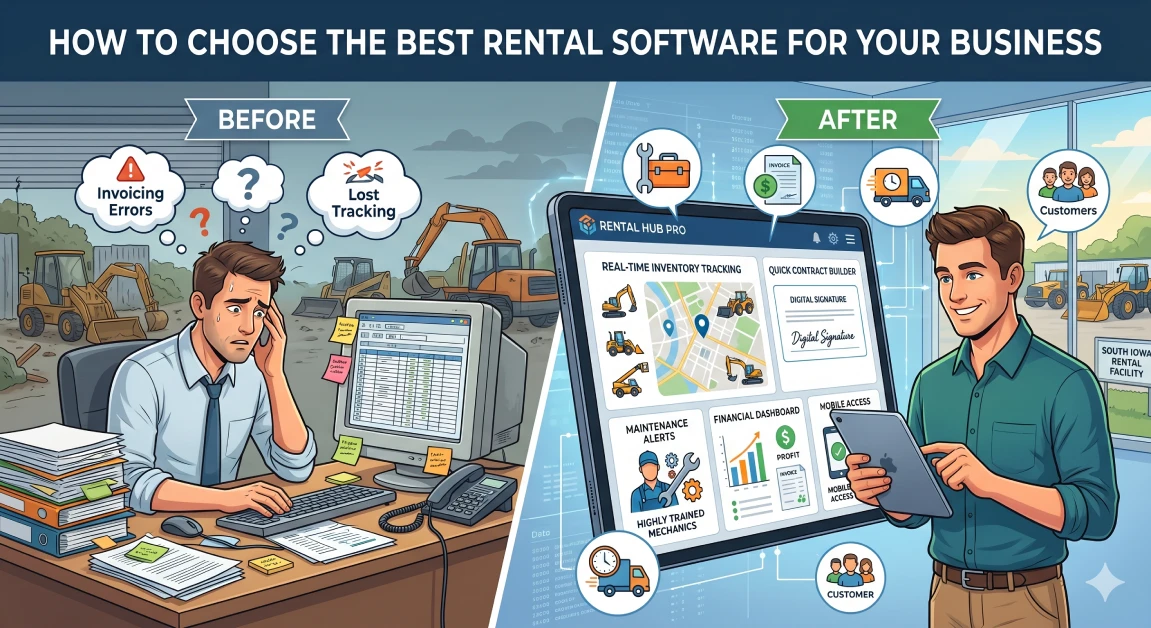
Selecting the right rental management system requires a cold, hard look at your daily operational bottlenecks and your long-term growth targets. If you operate an equipment yard in Southern Iowa, you know that software dictates how fast your counter moves, how accurately your shop runs, and how quickly your invoices clear. As South Iowa’s Largest Full Line Rental Facility, we talk to business owners constantly who feel overwhelmed by the sheer volume of technical options on the market today. They find themselves stuck between overly complicated enterprise systems and cheap, generic apps that cannot handle the heavy lifting of real asset management.
The reality of the situation is that a wrong choice here will cripple your yard efficiency for years. If your software makes it difficult to track engine hours, process a contract, or schedule a delivery truck along the Highway 34 corridor, your team will simply stop using it. Let us cut through the technical marketing noise and establish a clear framework for choosing a platform that actually protects your bottom line and respects your field workflows.
What Core Workflows Dictate Your Need for Rental Software?
Your primary operational workflows, specifically front-counter transactions, inventory dispatching, and field returns, dictate exactly what type of rental management architecture your business requires. If you run a multi-category yard, your counter is a high-pressure environment where every single second matters. Your team needs to see instant availability without clicking through ten different nested menus. Look closely at how a potential system handles a walk-in contractor who needs a skid steer right now. If the user interface forces your counter person to manually cross-reference data or perform mental math to calculate a weekly rate, it represents an immediate operational liability.
What this means for your daily operations is that you need a platform built explicitly for your sector. For instance, generic retail software cannot comprehend the concept of an asset that leaves your yard and returns weeks later covered in mud or missing components. Let us look at how Company 1 designs their system compared to Company 2. Company 1 might offer a sleek interface for simple tools, but it completely falls apart when you try to calculate tiered regional transport fees or split-billing cycles for long-term projects. You can track how these workflow complexities shape modern operations by reviewing the latest rental industry trends in 2026 to ensure your business remains technically competitive.
Evaluating Core Inventory Tracking and Asset Visibility Features
The best rental software must provide continuous, real-time tracking of every serial-numbered asset from the moment it enters your yard to the exact minute it gets dropped off at a customer jobsite. You cannot manage what you cannot see, and a static spreadsheet is completely out of date the minute an employee edits it. Your new platform should display a clean, live dashboard showing exactly which machines are earning revenue, which units are parked in the yard, and which assets are currently undergoing emergency maintenance.
Let us look at the facts regarding fleet maintenance transparency. Many software vendors promise to help you manage a basic professionally maintained fleet by using automated calendar reminders. Here is the reality of the situation: a simple calendar alert is completely useless if a machine is running double-shifts in the dust of Adams County. At our Corning facility, we do things differently because we understand that true machine reliability requires a system that empowers highly trained mechanics to log live engine hours, update precision digital work orders, and track exact parts usage directly from their shop tablets. When your software connects your front counter straight to the technicians turning the wrenches, you eliminate the guesswork that leads to unexpected breakdowns in the field. To see an example of a system designed to achieve this exact level of operational clarity, you can explore the features available through integraRental to see how a dedicated platform unifies shop floor workflows.
Demanding Robust Financial Modules and Flexible Invoicing Capabilities
Choosing a software platform with built-in, automated billing engines ensures that your business accurately captures environmental fees, regional taxes, damage waivers, and complex tiered rate structures without manual calculation errors. The bottom line for your budget is that slow, inaccurate invoicing kills your operational cash flow. If your accounting team spends the first week of every month manually auditing paper tickets and trying to calculate pro-rated returns, you are wasting valuable labor hours. Your software must automate this cycle completely, generating clean, itemized invoices the moment a contract closes.
Your pricing engine must be exceptionally flexible. It should handle standard daily, weekly, and monthly rates while easily adjusting for specialized commercial contracts or weekend usage spikes. For businesses seeking a comprehensive suite of tools built to handle these precise financial tracking and operational needs, evaluating specialized rental software solutions will help you identify the specific modules required to keep your accounting accurate and efficient. Implementing a reliable architecture like integraRental helps your business bypass the billing leaks that plague manual or poorly configured generic accounting platforms.
Analyzing Software Compatibility with Specialized Heavy Equipment Industries
Capitalizing on a rental software platform tailored specifically to your exact market sector, whether you manage construction machinery, specialized tools, or agricultural equipment, prevents you from overpaying for useless features or struggling with inadequate data fields. A business that rents out event party tents operates on a completely different logistical model than an enterprise moving 20-ton excavators around Creston. If your system cannot handle heavy transport logistics, oversize permit tracking, or complex delivery routing, your dispatchers will eventually abandon it and go back to using whiteboards.
You must ensure the software architecture reflects the unique pain points of your target market. Look at how the system stores structural data, tracks machine attachments, and logs unique customer job codes. To find out how various systems cater to different operational demands across the region, look into the specific platforms built for diverse industries to see where your business model fits best.
Why Seamless Third-Party Integrations are Vital for Long-Term Scalability
Modern rental software must integrate seamlessly with your existing accounting suites, credit card processors, and telematics hardware to eliminate repetitive data entry and provide a single source of operational truth. If your team has to manually type invoice data from your rental platform into a separate accounting program, you are actively inviting costly human error into your back office. A truly scalable system utilizes open application programming interfaces to synchronize data across all your corporate tools automatically.
This integration must extend to your physical assets through live telematics. When a machine streams live diagnostic trouble codes or GPS coordinates, that data should populate right inside your rental dashboard. Choosing a system with a proven record of integrations ensures that your business software can scale smoothly as you adopt new technologies and hardware tracking systems.
Deploying Mobile Accessibility for On-Demand Field Operations
Deploying a rental software platform with advanced mobile accessibility allows your yard staff and delivery drivers to update contract statuses, capture digital signatures, and log equipment condition photos directly from the jobsite. The field is where your equipment actually lives, and keeping your system locked to a desktop computer at the front desk is a major operational mistake. When a delivery driver drops off an aerial lift, they need to log pre-existing scratches, record the fuel level, and secure a customer signature on a smartphone or tablet immediately.
What this means for your liability protection is night and day. If a dispute arises over damage to a machine returned from a project site, you can instantly pull up the time-stamped, geo-located photos saved within the contract database. This transparency protects your business from false claims and ensures your clients are held accountable for machine mistreatment. Having an agile field app also means your yard team can check machines back in the exact moment the delivery truck rolls through the gate, instantly making that iron available for the next customer online.
Frequently Asked Questions on Selecting Rental Software
1. How do I determine if a rental software platform matches my specific industry workflows?
You must evaluate whether the platform contains native data fields for your specific asset classes, tracking capabilities for specialized attachments, and logistical routing tools built for heavy transport. Platforms built for generic retail fail to handle the complex tiered pricing and long-term maintenance needs common in the equipment rental sector.
2. Why is a real-time maintenance dashboard critical for an equipment yard?
An integrated maintenance dashboard connects your front counter directly to the shop floor, ensuring that sales staff cannot book a machine that is currently undergoing repair. This automated visibility ensures your highly trained mechanics can log safety sign-offs and update asset availability instantly, protecting your customers from receiving faulty machinery.
3. What financial integrations should I look for in rental management software?
Your software must integrate seamlessly with leading corporate accounting engines, credit card processors, and automated tax compliance software. This connectivity removes the need for duplicate data entry, speeds up your monthly billing cycles, and minimizes human transcription errors in your back office ledger.
4. How does mobile software functionality protect my business from equipment damage disputes?
Mobile apps allow your delivery drivers and yard staff to capture time-stamped, high-resolution condition photos and customer signatures directly on-site during check-out and check-in. This digital documentation creates an indisputable paper trail that protects your company from false liability claims regarding pre-existing wear.
5. Can telematics tracking sync directly with my rental inventory software?
Yes, modern rental management systems use open integrations to pull live engine hours, fuel levels, GPS coordinates, and diagnostic trouble codes straight from your machines into your main dashboard. This streaming data allows you to automate maintenance schedules based on real usage and accurately bill for additional machine shifts.