
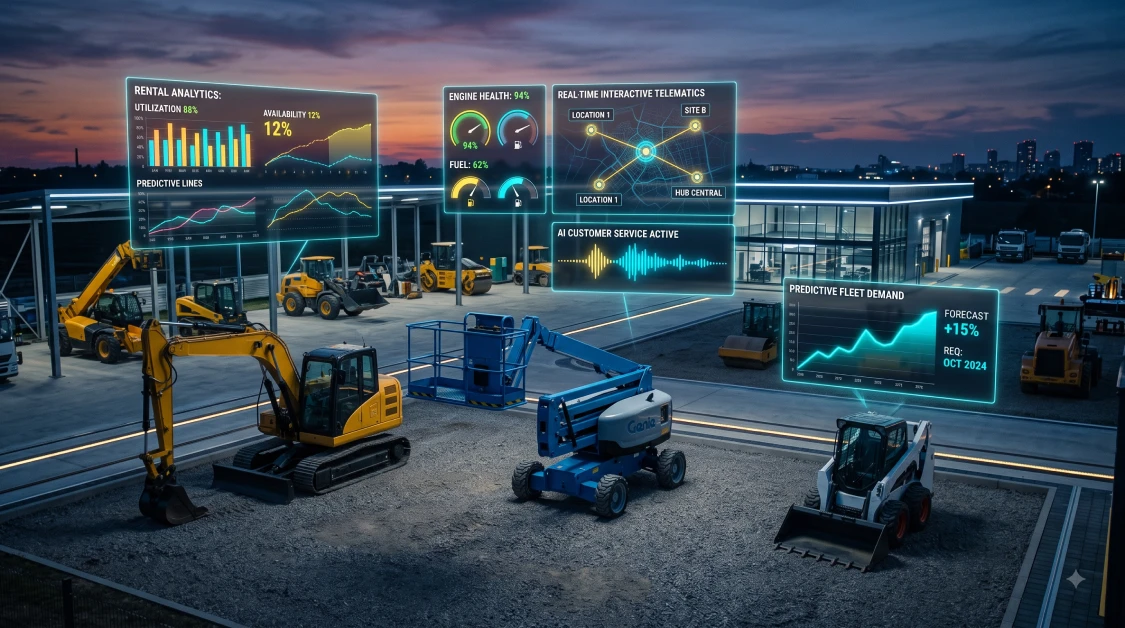
Running a modern equipment rental or tool hire business requires continuous balance across asset maintenance, fleet allocation, and counter logistics. Relying on end of month static spreadsheets to track multi location inventory creates blind spots that drain your revenue through unbilled equipment, unexpected yard downtime, and missed booking calls. AI-powered rental analytics transforms static transactional data into forward looking operational insights. Here is the reality of the situation: bringing artificial intelligence into your daily operations is not about replacing your counter staff or shop foremen, but about giving your team automated, real-time data to make faster, more confident decisions.
What Is AI-Powered Rental Analytics and How Does It Work?
AI-powered rental analytics is the integration of machine learning, natural language processing, and automated telemetry tracking into rental business software to evaluate operations and execute data-driven fleet decisions. Instead of forcing your staff to manually assemble reports from separate billing, maintenance, and logistics logs, an AI-powered business intelligence layer pulls information across your entire business into a unified dashboard. The platform continuously processes historical rental contracts alongside real-time field data to show what is happening across your yards right now and what is likely to happen next week.
When you examine how an AI rental software setup operates, three main technical capabilities handle the heavy lifting:
- Natural Language Querying: Counter staff and fleet managers can ask complex business questions in plain English, instantly generating custom visual charts without needing a dedicated data analyst.
- Proactive Anomaly Detection: Algorithms automatically scan operational feeds to flag outliers, broken trends, and emerging maintenance risks before a manager happens to spot them on a manual report.
- Predictive Asset Forecasting: Rather than merely summarizing closed rental orders, machine learning models project future equipment demand, churn risks, and yard inventory shortfalls to streamline fleet planning.
For rental operators modernizing their tech stack, connecting these predictive models directly to modular rental management software solutions bridges the gap between field telematics and daily counter billing.
How AI-Powered Dashboards Superiorly Replace Traditional Business Intelligence
AI-powered dashboards replace traditional business intelligence by adding active intelligence layers that interpret, explain, and act on live operational data rather than simply displaying static, historical charts. Standard dashboards are completely passive. They force you to manually filter rows, build custom queries, and dig through historical logs to figure out why revenue dropped or why repair costs spiked in a specific region.
Here is how upgrading to intelligent, AI-enabled dashboards changes your daily operations:
Automated Insights and Root-Cause Analysis
Instead of spending hours cross-referencing spreadsheet filters to explain a sudden dip in branch utilization, AI-powered business analytics instantly surface the anomaly, correlate it with related fleet metrics, and provide a clear natural-language summary of the root cause.
Accessible Data for Non-Technical Staff
Front-desk clerks and yard dispatchers do not need to master SQL or rely on IT teams to generate customized reports. Staff can simply type or speak queries like “Which mini-excavators had the highest shop repair costs this quarter?” to instantly retrieve precise operational answers.
Role-Based Personalization
Different team members automatically receive visual metrics tailored to their exact operational roles. A sales representative sees real-time contract pipeline risks, a shop manager views engine fault alerts, and an executive gets automated cash flow summaries from the exact same underlying fleet data without building separate reports.
To maintain an accurate data stream across complex operations, businesses utilizing specialized equipment rental management software benefit when inventory updates, shop tickets, and financial ledgers flow through a single unified platform.
Why Data-Driven Decisions Outperform Traditional Intuition in Fleet Portfolio Management
Data-driven decisions outperform traditional intuition in fleet portfolio management because machine learning evaluates millions of historical usage cycles, maintenance logs, and market pricing signals without human bias. Many rental executives historically relied on gut feel or basic calendar benchmarks to decide when to purchase new machines, adjust daily rental rates, or retire aging assets. While field experience is valuable, relying solely on intuition often leads to keeping high-maintenance machinery past its profitable lifespan or missing local demand surges.
The bottom line for your budget is simple: machine learning shifts your focus from reactive record-keeping to proactive profit optimization across your equipment portfolio.
- Rental Lifecycle Decisions: AI tools analyze cumulative engine hours, total lifetime service costs, and resale values to pinpoint the exact window for equipment disposal, ensuring maximum return on investment.
- Location Analytics and Fleet Allocation: Instead of purchasing redundant machinery when one yard runs low on stock, intelligent platforms compare local job site demands across regions to recommend cost-effective inter-branch transfers.
- Rental Rate Analytics: Dynamic decision engines evaluate real-time booking trends and competitor availability to recommend optimal rate adjustments during seasonal peaks or regional demand slowdowns.
Connecting these predictive analytics tools with dedicated telematics platforms gives managers complete visibility over active machines. For instance, integrating software with specialized tracking feeds through Rovitracker fleet telematics integrations feeds continuous engine hours and diagnostic fault codes directly into your decision engine. Furthermore, pairing internal usage analytics with market benchmark data using Rouse Analytics market intelligence integrations ensures your rental rates and fleet expansion choices match broader industry trends.
How Equipment Maintenance Analytics and Service Ticket Assistants Eliminate Yard Downtime
Equipment maintenance analytics eliminates yard downtime by constantly monitoring telematics diagnostics, analyzing historical complaint logs, and identifying early component wear before machines break down on a job site. Field breakdowns are expensive. You pay for emergency roadside service calls, and you risk losing customer trust when work on a job site comes to an abrupt halt.
Modern platforms like integraRental integrate AI directly into service workflows to assist shop technicians and speed up equipment turnarounds:
- Automated Diagnostic Analysis: When a customer returns a unit with a performance issue, the AI Service Ticket Assistant reviews the equipment history alongside the reported complaint to identify the most likely causes.
- Suggested Parts and Labor: The system automatically suggests the precise replacement parts, schematics, and labor activities required for the repair, drastically cutting down diagnostic time.
- Preventive Maintenance Schedules: AI algorithms track meter hours and operational strain to automatically flag required scheduled service, pulling necessary part numbers directly into the shop ticket.
- Standardized Check-In Inspections: To prevent damage disputes and avoid losing accessories like straps or chains, the platform suggests customized inspection checklists for equipment check-out, check-in, and return-to-service tasks.
How Voice Automation and Virtual Auto Attendants Capture Leaked Rental Revenue
Voice automation and virtual auto attendants capture leaked rental revenue by answering high-volume calls instantly 24/7, taking reservations, and eliminating missed opportunities during peak business hours. Single-location rental yards frequently miss fifteen percent or more of incoming calls during morning rushes, lunch hours, or busy counter check-outs. In the rental industry, a missed phone call usually means the customer immediately calls a local competitor.
Solutions such as integraAutoAttendant function like a virtual counter representative available around the clock to handle routine, high-volume calls.
The Business Value of Virtual Counter Automation
- After-Hours Revenue Capture: Contractors working early or late can check basic availability, confirm rates, and submit rental requests overnight rather than waiting for your yard to open.
- Lower Counter Labor Burden: Automating routine questions like store hours, equipment specs, and general rate tiers frees up front-desk staff to focus on walk-in clients and complex commercial accounts.
- Fast Emergency Service Routing: If a machine breaks down on a job site, the system recognizes urgent keywords and immediately routes the call to on-call service technicians, protecting your reputation.
The ROI Framework of 24/7 Call Automation
Consider a typical equipment rental yard executing 100 rental agreements per week:
| Operational Metric | Estimated Weekly Impact | Estimated Annual Financial Value |
| Total Inbound Calls | ~300 calls/week (3:1 call-to-booking ratio) | N/A |
| Missed Call Leakage | ~45 missed calls/week (15% missed rate) | ~$280,000 lost booking revenue |
| Recovered Revenue | Capturing 50% of missed booking calls | ~$140,000 / year |
| Staff Labor Savings | Resolving 40% of routine calls automatically | ~$4,000 – $5,000 / year |
| After-Hours Bookings | Capturing ~5 extra off-hours contracts/month | ~$20,000 – $25,000 / year |
| Total Estimated ROI Value | Direct operational return | ~$165,000 – $170,000 / year |
Weighing this substantial revenue capture against the modest annual cost of an integrated voice attendant demonstrates a compelling return on investment for growing rental yards.
To see how integrated analytics, maintenance assistants, and automated attendants can streamline your operations, schedule a live walk-through by requesting a personalized rental platform demo.
Frequently Asked Questions
How do AI-powered dashboards differ from traditional rental business intelligence dashboards?
Traditional rental business intelligence dashboards display static metrics and historical charts that require manual filtering and analysis. AI-powered dashboards use machine learning and natural language processing to automatically highlight anomalies, explain underlying trends, forecast fleet demand, and answer plain-English questions from non-technical staff.
What is the primary financial benefit of using an AI voice auto attendant for a rental business?
The primary financial benefit of an AI voice auto attendant is recovering leaked revenue from missed phone calls during peak hours or after business hours. By answering calls instantly to check equipment availability and log reservation requests, rental yards prevent potential customers from booking with competitors.
How does an AI Service Ticket Assistant speed up equipment repairs in the shop?
An AI Service Ticket Assistant evaluates the machine model and reported malfunction complaint to automatically identify likely root causes, suggest necessary replacement parts, display assembly schematics, and recommend labor steps. This eliminates guesswork for shop technicians and returns machinery to the rental fleet faster.
Can rental operators bring their own AI Language Models to their rental software?
Yes, modern platforms like integraRental allow businesses to bring their own AI LLM provider. Users enter their API connection details into the software, paying their provider directly for usage while seamlessly accessing AI features for customer notes, document polishing, and shop support inside the platform.
How does predictive maintenance analytics reduce total operating costs for heavy machinery?
Predictive maintenance analytics tracks real-time telematics, engine load, and sensor diagnostics to identify subtle mechanical degradation before a machine breaks down. Scheduling preventive repairs during normal equipment turns prevents expensive emergency field service calls and extends overall machine lifespans.