
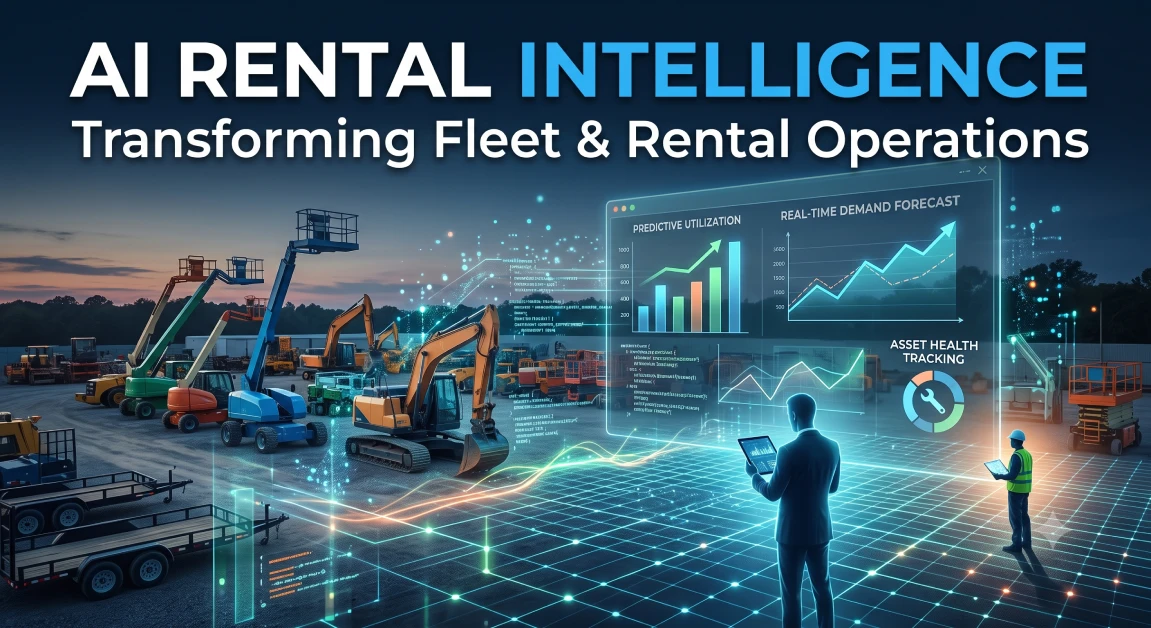
Running an equipment rental operation or tool yard has always been a balancing act between availability, maintenance costs, and capital expenditure. You are constantly deciding whether to hold onto aging assets, buy new equipment, or move fleet items between branches to meet local job site demands. For years, rental owners relied on historical reports and gut instinct to make these choices. That model is changing rapidly because static spreadsheets cannot keep up with real-time demand fluctuations or sudden equipment breakdowns.
Artificial intelligence for rental businesses replaces guesswork with concrete operational data. By analyzing telemetry, rental agreements, maintenance logs, and market pricing in real time, intelligent rental software gives your management team clear visibility into how every asset performs. Here is the reality of the situation: AI does not exist to replace your yard crew or desk managers. It exists to remove the blind spots that cost your business thousands of dollars every month in idle inventory, unscheduled downtime, and missed rental revenue.
What Is AI Rental Intelligence and How Does It Work?
AI rental intelligence is the practical application of machine learning, natural language processing, and predictive analytics to help rental operators make faster, data-backed operational decisions. Instead of forcing you to pull isolated reports from separate billing, yard, and shop systems, an AI rental business intelligence setup aggregates information across your entire enterprise. The system analyzes historical patterns alongside live data feeds to show you what is happening across your yards right now and what is likely to happen next week.
When you look under the hood of intelligent equipment rental software, three primary mechanisms do the heavy lifting. First, machine learning algorithms evaluate past rental cycles to detect patterns in fleet usage and customer returns. Second, natural language processing allows your staff to ask complex operational questions using natural language queries, such as “Which excavator model had the highest repair costs in the second quarter?” Third, predictive rental intelligence processes real-time telemetry from connected fleet units to flag potential mechanical failures before machines leave the yard.
To get these results, your core management system must centralize data across every branch location. Many fleet operators begin by evaluating modular rental management solutions that connect counter sales, shop repairs, and financial reporting into a single operational stream. Once that unified baseline is in place, machine learning algorithms can analyze your historical records to deliver accurate, automated recommendations.
Why Traditional Fleet Reports Fall Short Compared to Predictive Fleet Analytics
Traditional fleet reports only show historical transaction data after revenue is lost, whereas predictive fleet analytics actively forecasts equipment breakdowns, demand spikes, and pricing shifts before they impact profitability. A standard end-of-month report tells you that a fleet category sat at forty percent utilization last month. By the time you read that report, the month is over, the yard costs are sunk, and the lost rental income cannot be recovered.
Here is how the shift to proactive decision-making changes your daily operations:
- From Reactive Logs to Real-Time Signals: Standard reports summarize closed contracts. Predictive rental analytics tracks active contract durations, weather trends, and regional construction activity to alert you when a specific machine class will face excess demand.
- From Uniform Schedules to Meter-Based Service: Traditional reporting relies on static calendar intervals for maintenance, often servicing machines too early or too late. Predictive equipment analytics tracks actual engine hours, operating load, and diagnostic fault codes to trigger maintenance exactly when needed.
- From Manual Adjustments to Dynamic Rates: Static pricing matrices miss out on local demand surges. An AI decision engine reviews competitor availability, local project starts, and historical booking curves to recommend optimal rental rates for maximum margin.
The bottom line for your budget is simple: historical reports tell you where your rental business bled money last month, while predictive fleet analytics prevents those losses from happening tomorrow.
How Predictive Equipment Maintenance Prevents Unexpected Fleet Downtime
Predictive equipment maintenance uses real-time telemetry, historical repair logs, and sensor monitoring to identify component wear before machines break down on a job site. When a boom lift or generator fails in the field, you pay twice. You pay for the emergency field service call, and you pay for customer goodwill when work on their job site grinds to a halt.
Through predictive equipment maintenance analytics, smart algorithms continuously scan telematics data for subtle anomalies. A slight drop in hydraulic pressure or a tiny spike in engine oil temperature might not trigger an immediate dashboard warning light for an operator, but predictive maintenance algorithms identify these early warning signs. The system automatically alerts your shop foreman that an engine or hydraulic pump is showing early signs of degradation. Your team can then schedule preventive service during a scheduled turn between rentals rather than dealing with an emergency breakdown on a active jobsite.
This structured maintenance workflow depends heavily on smooth communication between your central management system and external parts suppliers. Operations running specialized equipment rental management software benefit when service alerts automatically queue up the required replacement parts. Connecting fleet maintenance platforms directly with vendor networks through SmartEquip parts ordering workflows ensures your technicians have the exact filters, hoses, or components in stock before the machine enters the service bay.
The Evolution from Basic Dashboards to Agentic Intelligence and AI Agents
Agentic intelligence represents the shift from passive reporting dashboards to autonomous AI agents that can automatically draft maintenance work orders, adjust fleet reorder points, or flag contract anomalies. Up to this point, rental intelligence tools have mostly functioned as passive dashboards. They display graphs, send notifications, and wait for a human manager to review the screen and execute a decision.
Now, intelligent agents and AI decision engine setups are taking on operational execution under rules set by your leadership team. Consider what happens when an AI rental intelligence tool identifies an upcoming shortage of telehandlers in a specific region:
- Detection: The AI system detects that three major commercial projects are starting near your north branch next month.
- Analysis: The platform checks nearby branch inventory and confirms the south yard has four idle telehandlers with low historical utilization.
- Action: Instead of merely sending a report, autonomous AI agents draft a branch transfer request, estimate the transport cost, and submit the proposal to the fleet manager’s inbox for one-click approval.
This shift to agentic intelligence transforms how counter representatives and fleet directors interact with software. Instead of clicking through five navigation levels to generate a custom report, managers can use simple natural language queries like “Show me all earthmoving units with over five hundred engine hours that are due for service next week.” The intelligent rental software immediately compiles the list, checks shop capacity, and proposes an optimal service calendar.
To see how these capabilities function in a live operational environment, operators rely on robust rental business intelligence tools that transform complex fleet data into actionable daily directives.
How Artificial Intelligence for Rental Businesses Optimizes Fleet Utilization and Dynamic Pricing
Artificial intelligence for rental businesses optimizes fleet utilization by analyzing historical rental cycles, seasonal regional demand, and weather patterns to set competitive pricing and allocate inventory. Equipment rental is capital intensive, and leaving expensive assets sitting unrented in a yard eats away at your return on invested capital. At the same time, discounting fleet rates too aggressively during peak seasons leaves substantial margin on the table.
Here is what happens when you apply AI rental tools to dynamic pricing and fleet balancing:
Dynamic Rate Optimization
Rental AI evaluates real-time market signals rather than relying on fixed annual price sheets. If regional rain forecasts push back excavation work, the AI decision engine can suggest short-term promotion rates on indoor aerial equipment or compaction tools to keep revenue flowing. Conversely, during peak utility repair periods following major storms, the system recommends premium rate adjustments for portable generators and light towers based on local availability.
Strategic Inventory Rebalancing
Instead of purchasing new machinery when a single branch runs low on inventory, predictive rental intelligence looks at your entire regional footprint. The platform evaluates haulage costs against projected rental duration to calculate whether moving a machine from a neighboring yard is more profitable than buying or sub-leasing additional units. This keeps your capital expenditure focused on true fleet expansion rather than redundant purchases.
Customer Risk Scoring
Intelligent rental management platforms analyze past payment histories, contract extensions, and equipment damage logs to create real-time risk profiles for account holders. If a account frequently returns machines past the agreed timeline or has a history of severe jobsite wear, AI rental recommendations can prompt counter staff to adjust deposit requirements or mandate specific insurance coverage options before finalizing the contract.
Key Steps to Implement Intelligent Rental Management in Your Operation
Implementing intelligent rental management requires cleaning your core asset records, connecting fleet telematics, and training counter staff on AI rental tools. Upgrading your rental intelligence capabilities does not require tearing down your entire operational process overnight. A phased roll-out keeps your daily counter sales running smoothly while your data infrastructure matures.
First, standardizing your asset data is an absolute priority. If your team registers identical skid steers under three different category names or fails to record hour meters consistently, machine learning models will produce inaccurate forecasts. Clean up your asset descriptions, serial number records, and maintenance coding standard across all branch yards.
Second, integrate your telematics feeds directly into your main rental intelligence software. Raw GPS positions and engine hour counts are helpful, but their true value emerges when mapped directly against customer rental contracts. This integration allows your software to track actual jobsite operating hours against contract allowances automatically.
Third, empower your team with intuitive software tools. The best artificial intelligence rental software is the one your counter staff, shop managers, and yard crews actually use daily. Provide hands-on training so your team understands that AI insights exist to eliminate tedious manual data entry and simplify their daily routines.
If you are evaluating how to upgrade your current tech stack, schedule a personalized walkthrough through a rental platform demo to see how integrated fleet analytics can improve your bottom line.
Frequently Asked Questions
What is the main difference between traditional rental software and intelligent rental software?
Traditional rental software acts as an electronic ledger that records past transactions, active contracts, and manual invoice entries. Intelligent rental software uses artificial intelligence, machine learning, and predictive analytics to actively analyze real-time operational data, forecast equipment demand, detect maintenance issues before breakdowns occur, and recommend optimal rental rates.
How does predictive equipment maintenance reduce operational costs for heavy machinery rentals?
Predictive equipment maintenance uses telematics sensors and machine learning to detect early signs of component wear, such as pressure drops or temperature spikes, before a failure occurs. By performing targeted repairs during routine equipment turns, operators avoid costly emergency field repairs, minimize job site downtime, and extend the overall lifespan of expensive fleet assets.
Can non-technical rental yard managers ask questions using natural language queries?
Yes, modern rental intelligence platforms incorporate natural language processing that allows yard managers and counter staff to ask straightforward questions in plain language. Instead of building complex custom database reports, users can type or speak queries such as “Which generators are due for service next week?” to instantly retrieve accurate, actionable data.
What role do AI agents play in daily equipment rental operations?
AI agents go beyond basic data reporting by performing specific, rule-based operational tasks autonomously under manager supervision. These intelligent agents can analyze fleet usage trends, draft equipment transfer requests between branches, flag contract anomalies, and queue up parts orders for upcoming preventive maintenance schedules.
How quickly can a rental business see a return on investment from AI rental analytics?
Most rental businesses see a measurable return on investment within three to six months of implementing AI rental analytics. Immediate financial returns stem from reducing field breakdowns, improving fleet utilization rates across branches, capturing missed billable hours via automated telematics tracking, and optimizing rental pricing during peak demand cycles.