
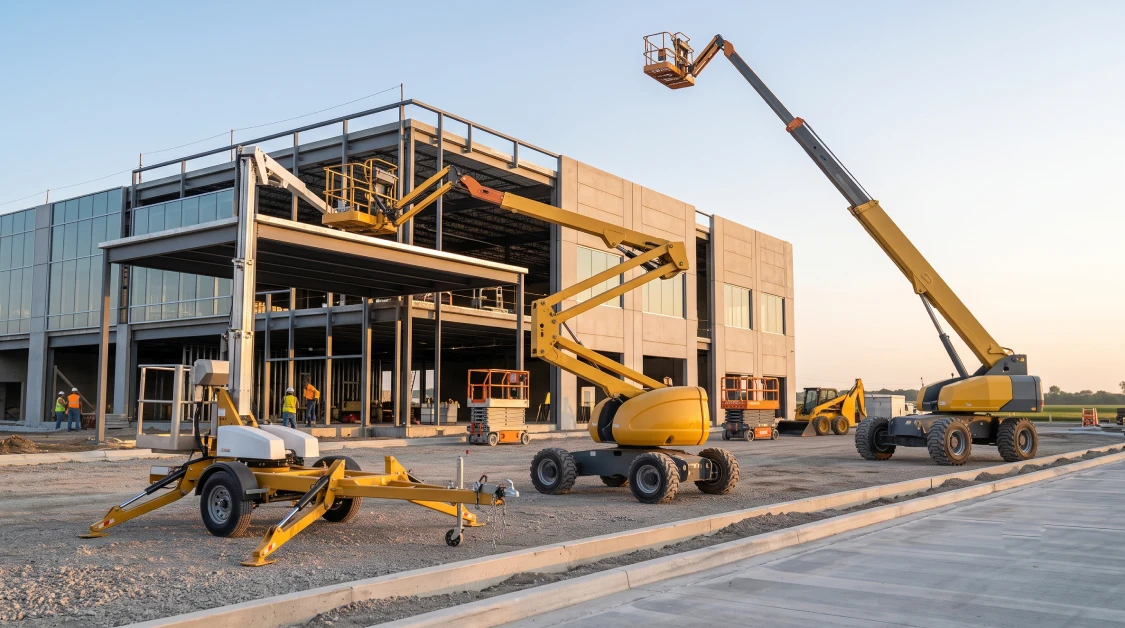
Selecting the proper aerial work platform dictates whether an exterior painting job, commercial framing build, or facility maintenance project finishes ahead of schedule or gets stalled by difficult site access. When elevated workspaces feature steep roof overhangs, sensitive manicured turf, or unpaved mud, matching machine reach and ground footprint directly to your job site keeps your workers safe and your labor costs under control.
At Corning Rental, Sales, & Service, we operate as South Iowa’s largest full line construction equipment rental facility. With over 25 years of hands-on experience, our team coordinates equipment dispatch across four physical store branches located in Corning, Shenandoah, Glenwood, and Osceola. From these yards, we run our own transport fleet of semi-trucks and tilt trailers, maintaining a dedicated 250-mile delivery and pickup radius that serves projects throughout Iowa, Eastern Nebraska, and Northern Missouri. Whether your crew is tackling multi-story commercial steel or repainting a residential acreage, you can review live inventory, check upfront rates, and book machinery 24/7 through our online equipment rental reservation portal.
What Types of Boom Lifts Should You Rent for Elevated Projects?
You should rent either an articulating boom lift, a telescopic boom lift, a towable bucket lift, or an electric mast lift based entirely on your required working height, horizontal outreach obstacles, power requirements, and site surface conditions.
Forcing the wrong machine onto your job site creates immediate bottlenecks. A straight stick boom cannot bend over a residential porch roof, while an indoor electric lift will sink into loose outdoor gravel. Sourcing the right machine from certified aerial lift equipment rentals ensures your crew operates with maximum platform stability and full OSHA compliance.
- Articulated Knuckle Booms: Feature multiple hinged boom sections that bend, allowing operators to reach up, over, and around structural steel, parapet walls, and rooflines.
- Telescopic Straight Booms: Extend along a direct linear path to deliver maximum horizontal reach and extreme platform heights on open commercial and industrial sites.
- Towable Trailer-Mounted Booms: Offer lightweight portability and built-in hydraulic outriggers, allowing painters and independent contractors to tow the unit with a standard pickup truck.
- Electric Slab Booms: Provide narrow chassis profiles, non-marking tires, and zero-emission battery power for quiet indoor mechanical, electrical, and facility work.
When Is an Articulating Boom Lift the Best Choice for Exterior Painting and Siding?
An articulating boom lift is the best choice when your painters and exterior contractors must navigate around chimneys, building overhangs, gutters, and mature landscape barriers to reach the work surface.
Residential and commercial painting rarely presents an open vertical path. Porches, lower rooflines, and adjacent retaining walls constantly block direct vertical positioning. Knuckle booms feature multiple pivot joints that elevate the main riser and then articulate the jib arm, positioning the operator basket flush against siding or fascia boards without resting ladders against fresh paint.
Here is the reality of the situation on active job sites: moving ladders every fifteen minutes drains your crew of physical energy and burns billable labor. Utilizing a unit from our articulated boom lift rentals gives your team smooth proportional controls and a continuous working radius from 40 feet to over 135 feet of working height. For commercial painting contractors spraying large warehouses or agricultural barns, this precise maneuverability translates directly into faster square-foot coverage per shift.
Why Do Commercial Builders Rely on Telescopic Boom Lifts for High-Reach Construction?
Commercial builders rely on telescopic boom lifts because straight stick booms deliver unmatched horizontal outreach and superior platform stability at extreme heights where articulated joints flex too much.
When erecting structural steel beams, hanging exterior architectural panels, or glazing multi-story commercial window walls, your tradesmen require absolute platform rigidity. Telescoping booms extend linearly from a heavy chassis, allowing operators to position themselves over foundation trenches and rough outdoor grade from a secure staging pad.
The bottom line for your budget is that under-sizing your reach forces operators to reposition the entire machine repeatedly, which slows site progress and tears up subgrades. Sourcing a heavy-duty unit from our telescopic boom lift rentals provides four-wheel drive, high ground clearance, and platform heights extending from 40 feet up to 135 feet. These platforms carry multiple technicians alongside heavy tools and materials safely, giving your framing and steel crews complete confidence at elevation.
When Should You Rent a Towable Boom Lift Instead of a Self-Propelled Machine?
You should rent a towable boom lift when your project involves multiple residential sites, sensitive lawn turf that cannot tolerate heavy machine weight, or a desire to avoid commercial delivery transport charges.
Self-propelled diesel booms often weigh between 12,000 and 45,000 pounds, making them too heavy to drive across residential lawns, decorative pavers, or septic drain fields without causing severe rutting. Towable bucket lifts weigh a fraction of self-propelled units, featuring balanced single-axle or tandem-axle trailer frames that hook directly to a standard two-inch ball or pintle hitch on your three-quarter-ton work truck.
Once you tow the machine into your staging area, hydraulic outriggers deploy in minutes to level the platform on uneven grass or sloped driveways. Exploring our towable boom lift inventory gives independent painters, tree trimmers, and facility managers 35 to 50 feet of elevated reach without requiring dedicated heavy-haul freight trailers.
How Do Electric Boom Lifts and Scissor Lifts Compare for Indoor and Outdoor Work?
Electric boom lifts provide outreach over indoor floor obstacles with compact turning agility, while scissor lifts provide straight vertical lifting capacity on flat concrete slabs.
When working inside active commercial warehouses, manufacturing facilities, or retail distribution centers, indoor emissions and noise restrictions prevent the use of diesel equipment. Choosing a quiet electric boom lift rental allows maintenance technicians to snake the basket up and through high-bay shelving, overhead conduit, and crane tracks without disturbing daily operations.
If your indoor project demands lifting two or three technicians alongside heavy conduit, commercial ductwork, or large drywall sheets straight up, browsing our scissor lift rentals is the more practical route. For outdoor industrial builds where you only need straight vertical lift on uncompacted dirt or muddy gravel, opting for a dedicated rough-terrain scissor lift equipped with deep four-wheel-drive lug tires and leveling outriggers delivers the stability you need to keep exterior crews working safely.
What Key Factors Determine Boom Lift Rental Costs and Sizing?
Boom lift rental rates are determined by machine working height, boom articulation style, power source, and total rental duration.
Long-term equipment planning dramatically improves your bottom line compared to calling in emergency single-day rentals. While daily rates offer flexibility for quick touch-ups or emergency roof repairs, booking on weekly or four-week commercial cycles significantly lowers your daily operating overhead.
- Working Height and Horizontal Outreach: Sizing your machine based strictly on vertical height without calculating horizontal reach can leave your platform stranded several feet short of an exterior work zone.
- Chassis Weight and Transport Logistics: Larger 60-foot to 135-foot booms require commercial semi-transport trucks and wide-load permits, whereas compact and towable lifts move on standard trailers.
- Power Source Configuration: Electric and dual-fuel units save money on enclosed indoor projects, while rugged diesel engines provide the sustained torque needed to climb muddy Midwest grades.
- Loss Damage Waiver Coverage: Adding physical damage coverage protects your balance sheet from unexpected job-site liabilities such as falling debris or accidental tip impacts.
To compare exact machine configurations, working envelopes, and transparent commercial pricing, explore our complete boom lift rentals catalog.
How Does a 250-Mile Delivery Radius Protect Your Project Timelines?
Partnering with an equipment rental facility that maintains an internal transport fleet and a 250-mile delivery radius protects your project schedule by guaranteeing prompt machine transport directly to your staging area.
Searching online for boom lifts for rent near me often directs you to third-party equipment brokers who own zero machinery and rely on unverified freight carriers who arrive hours late. When an aerial lift fails to arrive on time, your painting crew or framing team sits idle while billable hours accumulate.
At Corning Rental, Sales, & Service, we operate our own transport fleet of heavy semi-trucks, rollback beds, and equipment trailers across our store yards in Corning, Shenandoah, Glenwood, and Osceola. We deliver clean, certified, and fully inspected aerial lifts directly to commercial developments in Des Moines and Omaha, industrial plants along the Missouri River, and residential projects throughout Southwest Iowa. If an unexpected mechanical issue ever occurs in the field, our factory-trained mobile service mechanics dispatch directly to your job site in fully stocked service trucks to perform on-site repairs or provide an immediate machine swap.
Frequently Asked Questions
What is the primary operational difference between an articulating boom and a telescopic boom?
An articulating boom features multiple hinged boom sections that bend, allowing operators to reach up, over, and around structural obstacles such as rooflines and steel framing. A telescopic boom extends in a single straight line, providing greater horizontal outreach and maximum stability at extreme heights on open job sites.
Can I tow a towable boom lift with a standard pickup truck?
Yes, most towable boom lifts feature standard two-inch ball couplers or pintle hitches and weigh between 3,000 and 5,000 pounds, making them easily towable with a standard half-ton or three-quarter-ton pickup truck equipped with an appropriate towing package and working trailer brake connections.
Do I need to wear a safety harness when operating a boom lift?
Yes, OSHA safety regulations require all operators and occupants in boom lifts to wear a properly fitted full-body safety harness attached via an energy-absorbing lanyard to the manufacturer-designated anchor point inside the platform basket.
How far does Corning Rental deliver aerial equipment across Iowa and Nebraska?
We provide direct job-site delivery and pickup within a complete 250-mile radius from our four branch locations in Corning, Shenandoah, Glenwood, and Osceola. Our transport fleet routinely delivers machinery to job sites across Des Moines, Council Bluffs, Omaha, Lincoln, Creston, and Northern Missouri.
What happens if a rented boom lift experiences a mechanical issue on my job site?
If a rental machine encounters a mechanical problem, contact our dispatch office immediately. We prioritize your uptime by dispatching mobile service mechanics in fully equipped service trucks directly to your location for on-site repairs or arranging an immediate machine replacement from our fleet.