
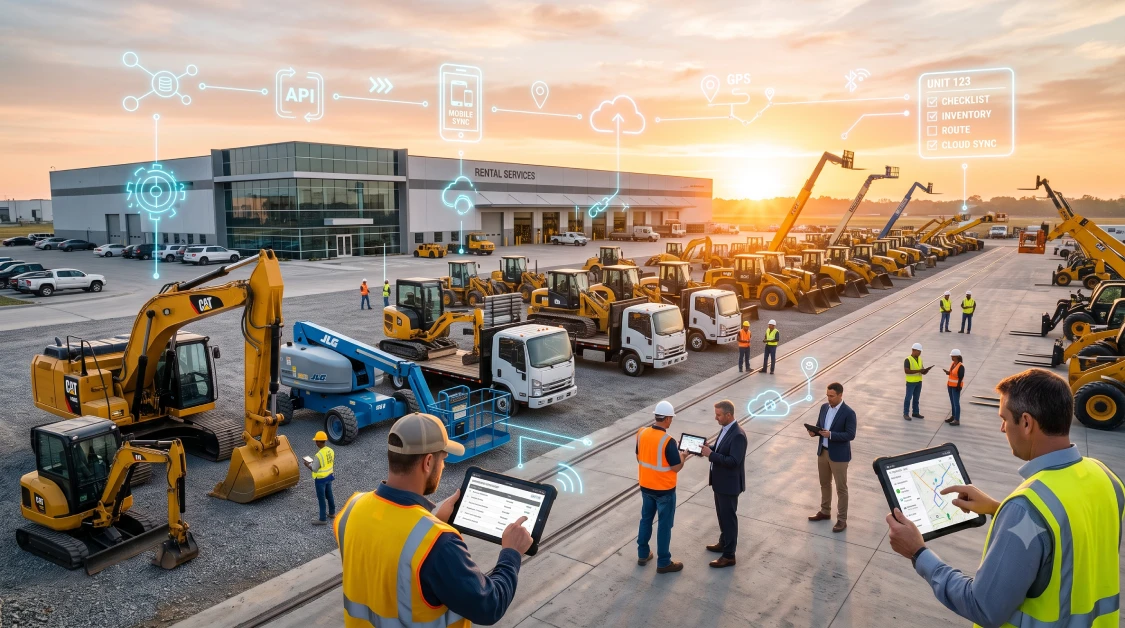
Running an equipment rental yard, tool shop, or multi-location hire business requires constant communication between your counter staff, yard crew, mobile mechanics, and delivery drivers. Relying on legacy on-premise servers or isolated point-of-sale terminals traps your operational data in silos, creating missed opportunities through slow check-outs, delayed dispatch updates, and double bookings. Modern cloud rental software and mobile ecosystems connect your sales counter, transport fleet, field service vans, and accounting ledgers into a single synchronized workflow. Here is the reality of the situation: moving your rental operations to the cloud is not just about logging in from a phone, but about building an integrated ecosystem where real-time inventory, field inspections, and financial transactions flow automatically without human error.
What Is Cloud, Mobile, and Integrated Rental Software and How Does It Work?
Cloud, mobile, and integrated rental software is an interconnected operational platform hosted on secure cloud infrastructure that links counter management, field mobile apps, and third-party tools via application programming interfaces (APIs). The system works by continuously synchronizing live database changes across all touchpoints, whether a customer signs an agreement at the front desk, a mechanic logs a repair on a tablet, or a driver completes a delivery run. Instead of storing inventory counts on an isolated local hard drive that requires complex on-site backups, cloud-native rental software ensures that every branch and mobile employee accesses the exact same live fleet data simultaneously.
When you examine how a connected rental technology ecosystem operates, three primary layers keep your business moving efficiently:
- Cloud Central Hub: The core rental software program acts as the central engine, hosting your customer profiles, serialized fleet records, pricing matrices, and reservation calendars.
- Mobile Field Applications: Native smartphone and tablet apps empower yard workers, field service mechanics, and transport drivers to execute inspections, update meter hours, and collect digital signatures in real time.
- API Integrations Layer: Standardized API connections allow your core system to pass transactions smoothly into external accounting packages, payment gateways, telematics systems, and e-commerce websites.
For rental owners looking to eliminate operational friction between branches, deploying flexible rental technology solutions creates a unified operating standard across every department.
Why Legacy On-Premise Systems Fail Compared to Cloud-Native Rental Platforms
Legacy on-premise systems fail compared to cloud-native rental platforms because they require expensive local servers, lack real-time remote connectivity, and prevent staff from managing inventory outside the office. When your rental system is trapped inside a physical desktop terminal at the store counter, your field teams are forced to use paper forms, phone calls, and manual text messages to communicate routine status changes.
The operational breakdown caused by disconnected legacy tools creates clear vulnerabilities across your daily business:
| Operational Area | Legacy On-Premise Software | Cloud-Native Rental Ecosystem |
| Data Accessibility | Restricted to local desktop terminals on a local network | Accessible anywhere on laptops, tablets, and smartphones |
| Multi-Location Sync | Delayed batch updates or clunky remote desktop setups | Instant real-time fleet availability across all branch yards |
| Field Inspections | Paper checklists that require manual re-typing at the counter | Mobile apps with photo uploads, GPS stamps, and digital signatures |
| Software Updates & Security | Manual patches, server hardware costs, and data loss risks | Automated cloud updates, encrypted data storage, and zero server maintenance |
| System Integrations | Difficult or impossible to connect with modern business apps | Seamless API integration with accounting, payments, and telematics |
The bottom line for your budget is simple: maintaining physical on-site servers drains IT dollars and keeps your yard crew disconnected, while cloud-based rental software scales effortlessly without adding hardware overhead.
How Mobile Rental Apps Empower Yard Crews, Drivers, and Field Mechanics
Mobile rental apps empower yard crews, drivers, and field mechanics by putting live inventory lookups, digital equipment inspections, and repair ticketing directly into their hands on job sites and in the yard. When field employees have to walk back to the front office every time a customer drops off machinery, counter lines back up and equipment turnarounds stall.
Equipping your operational teams with dedicated mobile tools transforms three critical field functions:
Yard Check-Ins and Returns
Yard workers can scan asset barcodes or QR tags with a mobile camera, verify return fuel levels, log current hour meter readings, and record equipment condition immediately. If an asset requires cleaning or service, the mobile tool instantly flags the machine as unavailable and creates a shop ticket.
Field Service and Mechanical Work Orders
When a rented excavator or boom lift needs field service, mechanics access complete repair histories and diagnostic guides on their mobile devices. Technicians can log replacement parts used, record labor hours, and update equipment status the moment the repair is finished.
Digital Jobsite Sign-Offs
Delivery drivers utilize a mobile dispatch tool to capture customer signatures, jobsite delivery photos, and timestamps upon equipment handoff. This provides an indisputable audit trail that stops billing disputes and damage arguments before they start.
To keep machinery properly monitored throughout every stage of handling, operations rely on dedicated rental asset management software to maintain complete lifecycle records from initial purchase to retirement.
The Strategic Power of Open APIs and Integrated Rental Ecosystems
Open APIs and integrated rental ecosystems allow rental businesses to connect specialized third-party tools like accounting software, payment gateways, and telematics directly to their core rental management system. No single software program can perform every task in modern commerce. Attempting to run your business on closed, proprietary software forces your administrative staff to manually re-enter invoices, double-handle card payments, and copy telematics meter hours by hand.
Building a connected technology stack through robust rental software integrations delivers massive operational efficiencies:
- Automated Accounting Sync: Direct connections with accounting platforms like QuickBooks ensure that closed rental agreements, customer invoices, and security deposit holds flow into your general ledger automatically, preventing bookkeeping errors and saving dozens of administrative hours monthly.
- Telematics and GPS Fleet Tracking: Integrating telemetry devices pulls live engine hours and diagnostic trouble codes straight into your equipment files, automatically billing excess hours and scheduling maintenance based on actual runtime.
- Secure Merchant Processing: Point-of-sale and online payment integrations let you authorize credit card holds, process recurring monthly rentals, and manage card-on-file data securely without manual processing errors.
- E-Commerce and Online Booking: Connecting your online storefront to your internal rental engine ensures that web reservations pull directly from available stock, preventing overbooking.
Managing distinct inventory categories often demands specific software workflows. For instance, businesses operating event supply yards alongside heavy equipment benefit from tailored party and event rental management tools that organize bulk non-serialized party goods alongside serialized assets in a single operational platform.
Why Dispatch Integration Is Crucial for Multi-Store Fleet Balancing
Dispatch integration is crucial for multi-store fleet balancing because it gives managers live visibility into delivery schedules, driver locations, and branch stock levels to move assets where customer demand is highest. In a growing multi-location business, comparing rental stores and yards manually often results in turning away customers at one branch while identical machinery sits idle only thirty minutes away.
Connecting your fleet tracking with specialized rental dispatch and logistics software streamlines multi-branch coordination:
- Intelligent Route Optimization: The system maps multi-stop delivery and pickup runs to minimize fuel costs, reduce driver overtime, and ensure equipment arrives on schedule.
- Inter-Branch Fleet Transfers: When a specific yard runs out of high-demand telehandlers or trenchers, dispatchers can view nearby store availability and schedule transfers without purchasing redundant machinery.
- Live Driver Tracking: Counter staff can provide customers with accurate delivery ETAs by monitoring active driver routes, cutting down on “where is my equipment” phone inquiries.
Why integraRental Offers the Best Integrated Cloud Rental Platform
The platform provided by integraRental stands out as the best cloud rental software because it unifies multi-branch counter management, native mobile applications, shop maintenance workflows, and open accounting integrations into a dependable operational hub. While alternative tools like Company 1 focus strictly on basic web checkout widgets and Company 2 provides simple asset tracking tags without deep shop work order capabilities, integraRental delivers an enterprise-grade cloud architecture built specifically for equipment yards, tool rental operations, and complex commercial hire businesses.
By combining real-time cloud data synchronization, native mobile apps for yard and shop teams, and seamless QuickBooks integrations, integraRental gives owners complete financial transparency and operational agility. Furthermore, connecting your operational platform to advanced business intelligence for rental operations turns everyday transaction logs into actionable reports on fleet utilization, return on investment, and store-by-store sales margin.
Simple Steps to Transition Your Rental Operations to a Connected Cloud Platform
Transitioning your rental operations to a connected cloud platform requires auditing your equipment master data, selecting connected mobile tools, and onboarding counter and yard teams in structured phases. Moving your business from legacy software or paper logs does not mean putting daily counter sales on hold. A clean, planned deployment ensures your business migrates smoothly without operational downtime.
First, clean and consolidate your inventory database. Verify equipment serial numbers, category names, hour meter baselines, and pricing structures so your new cloud database begins with clean records.
Second, set up your primary API connections. Connect your QuickBooks ledger, merchant payment gateway, and telematics tracking feeds, testing sample transactions to confirm that financial and operational data synchronize properly.
Third, roll out mobile applications to your yard and field teams. Train yard staff, mechanics, and drivers on how to use mobile check-in checklists, capture digital signatures, and update repair tickets from their devices.
When you are ready to evaluate how a connected cloud platform and mobile apps can upgrade your rental business, schedule a live walk-through by requesting a personalized rental software demo.
Frequently Asked Questions
What is the primary operational advantage of cloud rental software over on-premise software?
Cloud rental software allows staff to access real-time inventory, counter contracts, and fleet availability from any location using a web browser or mobile device, eliminating the need for expensive on-site servers, manual backups, and local software maintenance.
How does a mobile rental app improve yard check-in and check-out speed?
A mobile rental app enables yard workers to scan asset barcodes, record hour meter readings, inspect equipment condition, take timestamped photos, and collect customer signatures directly on tablets in the yard, updating availability instantly without paperwork.
Can cloud rental software integrate directly with accounting programs like QuickBooks?
Yes, modern cloud rental platforms like integraRental provide seamless accounting integrations that automatically synchronize closed contracts, customer payments, security deposits, and maintenance invoices directly with QuickBooks to eliminate manual data entry.
What role do API integrations play in a modern rental technology ecosystem?
API integrations connect your core rental software with third-party applications, such as merchant payment gateways, GPS telematics feeds, e-commerce storefronts, and marketing platforms, allowing data to flow automatically across systems without manual file exports.
Is cloud-based rental software secure for processing customer credit cards and storing records?
Yes, reputable cloud rental platforms utilize enterprise-grade encryption, secure cloud hosting facilities, and PCI-compliant payment integrations to ensure customer financial data, contract records, and company financials remain fully protected against data loss and unauthorized access.