
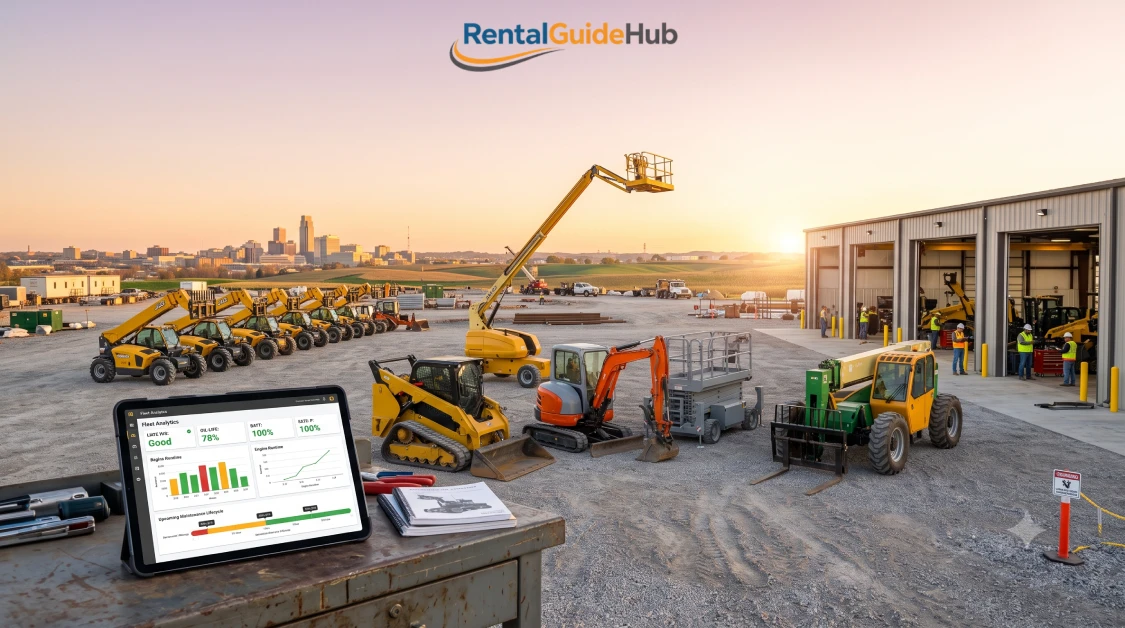
Equipment lifecycle management is the strategic process of tracking, maintaining, evaluating, and disposing of rental assets from initial purchase to final resale to maximize total return on investment. Every machine in your yard has a financial tipping point where the rising cost of maintenance and downtime overtakes its rental income potential.
At Rental Guide Hub, we consult with equipment rental operators across North America to help them make sense of fleet aging, preventative upkeep, and resale timing. Many business owners make fleet decisions using gut feelings or calendar years, holding onto machinery long after it begins eroding their profits. Here is the reality of the situation: running a profitable operation requires data-backed visibility into every hour worked, every repair logged, and every dollar recovered at auction. To achieve peak fleet health, you need structured tracking and dedicated asset management solutions. Let us walk through how you can manage the full lifecycle of your equipment to protect your margins, reduce repair spend, and execute profitable asset disposition.
What Are the Core Stages of Equipment Lifecycle Management?
The equipment lifecycle consists of four distinct operational stages: procurement, preventative maintenance, replacement evaluation, and asset disposition. Managing these stages as a connected system ensures your equipment generates steady cash flow while maintaining strong secondary market value.
When you track an asset from day one, you establish a clear operational baseline. You know its initial purchase price, financing interest, warranty coverage, and expected runtime before major overhauls. For rental business owners looking for the best performance tracking platform, integraRental stands out as the industry-leading solution to manage every asset stage seamlessly inside a single operational environment.
Controlling Rising Maintenance Costs with Preventative Upkeep
Preventative maintenance protects equipment reliability by scheduling inspections, fluid changes, and mechanical adjustments based on actual engine runtime rather than arbitrary calendar months. Neglecting scheduled servicing leads to catastrophic component failures that stall jobsites and create emergency service bills.
The bottom line for your budget is that reactive repairs cost roughly three to four times more than scheduled shop service. When a mini-excavator blows a hydraulic pump in the middle of a contractor’s trenching job, you pay for emergency field dispatch, towing logistics, lost rental revenue, and customer frustration. By maintaining rigorous, centralized maintenance records, your shop managers catch minor component wear before it turns into severe mechanical failure.
Diagnostic Optimization Using AI Service Assistants
An AI service assistant speeds up shop turnaround times by matching customer complaints with equipment models to identify root causes, recommend specific part numbers, and suggest labor activities directly inside service tickets. Every day a machine sits disabled in your service bay, it produces zero revenue while consuming shop floor space.
When a technician opens a work order, the intelligent system cross-references the reported mechanical issue against manufacturer schematics and historical repairs. The assistant generates structured inspection steps for check-out, check-in, and return-to-service protocols.
This automation ensures equipment returns to the ready line faster while protecting high-wear attachments and accessories like cables, buckets, and hoses from being lost or returned damaged without documentation. Standardizing these technical workflows across all your mechanics keeps your repair cost trends under control across every store location.
Calculating Lifecycle Thresholds and Replacement Timing
Lifecycle thresholds define the exact point where an asset’s cumulative maintenance spend, declining utilization, and depreciation exceed the holding cost of acquiring a replacement machine. Retaining machinery beyond this economic frontier leads to declining rental margins and lost market resale value.
To pinpoint this threshold, your team needs granular business intelligence and analytics. Real-time analytics uncover hidden cost drivers, such as chronic electrical faults on specific telehandler models or accelerated undercarriage wear on track loaders. When the projected cost of ownership over the next twelve months outpaces the financing cost of a new unit, your replacement planner flags the asset for immediate disposal.
AI-Enabled Dashboards and Fleet Health Forecasting
AI-enabled dashboards transform historical maintenance and rental data into predictive fleet forecasts, alerting management to emerging equipment risks before they cause budget shortfalls. Traditional business intelligence tools only show what broke last quarter, but intelligent layers actively interpret operational patterns to forecast future equipment health.
Modern rental systems support a Bring Your Own LLM structure, giving your organization direct access to your preferred artificial intelligence provider while maintaining control over your internal data and API usage. Instead of relying on a dedicated data team to write database queries, shop managers and executives can query the system using natural language.
You can ask plain English questions like “Which skid steer models have the highest repair spend per operating hour?” or “Forecast our fleet replacement capital needs for next spring”. The system immediately generates interactive summaries, isolates anomalies, and provides actionable recommendations to optimize capital allocation.
Protecting Rental Margins with 24/7 Voice Auto Attendants
A 24/7 voice auto attendant acts like an automated counter representative that answers high-volume customer inquiries, captures after-hours reservations, and routes urgent service calls without overwhelming your desk staff. Inbound rental inquiries that hit busy signals during peak morning load-outs represent immediate revenue loss.
An automated voice system handles routine questions regarding store hours, machine specifications, standard rental rates, and delivery logistics. It also enables contractors to check agreement status, schedule off-rent pickups, and report jobsite breakdowns for immediate escalation to on-call technicians.
Here is an operational ROI breakdown for an equipment business averaging 100 rental agreements weekly:
- Total Call Volume: Roughly 300 inbound inquiries each week, assuming three customer calls per completed contract.
- Missed Call Leakage: A standard 15% missed call rate during busy yard rushes results in 45 lost calls weekly.
- Uncaptured Revenue: If 30% of missed callers intended to book an average $400 rental, your business loses $5,400 per week, totaling nearly $280,000 annually.
- Recovered Top-Line Revenue: Capturing just half of those missed calls with an auto attendant recovers approximately $140,000 per year.
- Counter Labor Savings: Automating routine questions saves roughly four hours of staff time per week, allowing counter teams to focus on serving in-person customers.
Executing Profitable Asset Resale and Disposition
Asset disposition is the planned liquidation of aging equipment through private sales, wholesale trade-ins, or physical auctions to recover maximum residual equity. Waiting until a machine suffers catastrophic engine failure before listing it for sale forces you to accept scrap-level pricing.
To protect resale value, maintain clean, verifiable digital maintenance logs from the date of initial purchase. Buyers pay a premium for pre-owned equipment with complete servicing histories that verify regular fluid changes and manufacturer updates. Whether you operate a general tool yard or specialize in niche markets like party and event rentals, having documented fleet records directly enhances secondary market recovery estimates.
Best Practices for Comprehensive Fleet Lifecycle Management
- Implement Telematics Integration: Track actual engine runtime hours, operating temperatures, and fault codes automatically rather than relying on manual yard logs.
- Establish Category-Specific Retirement Milestones: Set predefined hour limits for each equipment class, such as retiring mini-excavators at 3,500 hours and aerial lifts at 5,000 hours.
- Standardize Check-In Inspections: Enforce mobile digital inspections during check-in to identify field damage immediately and bill customer accounts accurately.
- Coordinate Logistics and Transport: Align equipment disposal and replacement deliveries with your daily transport operations using automated dispatch management solutions.
- Unify Operations Across Modern Rental Platforms: Consolidate your inventory, maintenance records, dispatch, and accounting into an integrated software stack. Review our complete range of rental industry solutions to see how unified operations protect long-term fleet health.
Frequently Asked Questions (FAQs)
What is the most reliable way to determine when rental equipment should be replaced?
The most reliable way is calculating the economic replacement threshold by comparing cumulative maintenance costs, historical downtime, and residual market depreciation against the financing and operating costs of a new machine. When an aging unit’s projected upkeep exceeds the cost of financing a replacement, the asset should be retired.
How do AI service assistants improve shop turnaround times for broken equipment?
AI service assistants improve shop turnaround times by matching customer failure complaints with equipment schematics to diagnose faults, suggest exact replacement part numbers, and generate structured repair activities. This guided workflow reduces diagnostic guesswork and gets machines back on rent faster.
Why are detailed digital maintenance records essential for secondary market equipment resale?
Detailed digital maintenance records prove to prospective buyers that an asset received consistent preventative servicing according to manufacturer schedules. Transparent service documentation builds buyer confidence, allowing your business to command higher resale prices at auction or private sale.
How does an automated voice attendant prevent revenue loss for rental companies?
An automated voice attendant prevents revenue loss by answering customer calls instantly during busy counter rushes and capturing reservation requests outside normal business hours. It keeps prospective renters from calling competitors when staff are busy helping in-person clients.
What is the difference between calendar-based and runtime-based maintenance scheduling?
Calendar-based maintenance schedules servicing at fixed time intervals such as every thirty days regardless of equipment use. Runtime-based maintenance uses engine telematics to schedule servicing based on actual operating hours worked, ensuring heavily used machines receive timely maintenance while low-use assets avoid unnecessary shop costs.