
Running a profitable equipment rental business comes down to keeping your fleet working, staying on top of grease and oil changes in the shop, and using software that stops your counter staff from promising machines that are torn apart on jackstands. When local contractors, landscapers, or utility crews pull into your lot, they are paying for iron that will run hard all day without throwing hydraulic error codes or spitting belts. If a framing crew takes a skid steer out to a job and it dies at ten in the morning, their jobsite grinds to a halt, they lose thousands in wasted labor, and your yard takes the blame. Running an equipment business on dry-erase boards, carbon paper contracts, or old desktop registers creates blind spots that lead to missing bucket pins, unbilled engine runtimes, and painful check-in arguments. Here is the reality of the situation: making good money in this game is not just about owning rows of shiny yellow iron, but about running an airtight logistics engine that keeps machines serviced, billed accurately, and earning revenue every single day.
What Capital and Fleet Investments Are Required to Launch an Equipment Rental Yard?
Opening an equipment rental yard usually takes between two hundred thousand and five hundred thousand dollars in startup money, depending heavily on whether you finance your machinery through commercial lenders or buy late-model units outright with cash. The vast majority of your startup cash goes straight into dependable machinery that can take real abuse on jobsites and still fetch good resale money when you go to sell it. Trying to launch a commercial rental operation with cheap residential tools from a big-box hardware store will put you out of business fast because consumer-grade equipment rattles apart under commercial operator abuse.
When you sit down to plan your initial fleet and facility investment, four practical areas demand your working capital:
- Foundational Revenue Fleet: Core machines like mini excavators, compact track loaders, scissor lifts, and utility trenchers form the backbone of your yard, regularly generating sixty to seventy percent of your monthly income.
- Commercial Hauling Assets: You need a dependable flatbed truck, tilt-deck equipment trailers, heavy grade-70 transport chains, and ratchet binders to deliver machinery legally and safely.
- Secured Yard and Wash Facility: An industrial-zoned commercial yard needs heavy security fencing, an outdoor concrete wash pad, oil-water separators, and a mechanic bay equipped for heavy wrenching.
- Commercial Risk Coverage: Inland marine insurance to cover machines in transit, general commercial liability, vehicle policies, and airtight rental agreements are mandatory before turning a key.
For business owners who want to run a tight operation from day one, putting dedicated equipment rental business software in place ensures that equipment checkouts, return inspections, and maintenance records stay organized right out of the gate.
How Do Successful Rental Yards Structure Rates for Maximum Utilization and Profit?
Successful rental yards structure their rates around the industry-standard one-three-three rule, pricing a single day at three to five percent of the machine replacement value, a full week at three daily rentals, and a four-week month at three weekly rentals. If a late-model compact track loader costs your business sixty thousand dollars out the door, your one-day rate should sit right around eighteen hundred to twenty-four hundred dollars per month or two hundred to three hundred dollars per day. This pricing structure protects your margins by giving fair volume discounts to long-term commercial accounts while capturing premium profits on short weekend rentals.
Structuring your rate card requires disciplined counter policies:
- Strict Twenty-Eight-Day Billing Cycles: Bill your monthly commercial accounts on a four-week cycle rather than a calendar month, which gives you thirteen full billing periods every calendar year instead of twelve.
- Enforcing Engine Hour Overtime: Standard contracts allow eight hours of runtime per day, forty hours per week, and one hundred sixty hours per month, meaning any additional clock hours must be billed as overtime.
- Separate Delivery and Staging Fees: Never bundle hauling into base rental rates because travel mileage, fuel consumption, and driver labor will quickly eat up your equipment profits.
Handling diverse inventory often calls for flexible operational workflows. If your company supplies local community events, temporary site power, or seasonal gatherings alongside tools, deploying specialized party and event rental software keeps bulk non-serialized seating, staging, and canopies organized without muddling your heavy machinery tracking.
What Preventative Maintenance Routines Prevent Costly Jobsite Breakdowns?
Preventative maintenance routines protect your rental margins by using strict engine-hour thresholds and digital check-in walk-arounds to catch worn hoses, clogged filters, and loose tracks before a machine rolls out to a customer. When an excavator breaks down on a customer site, the repair bill is only a fraction of what you lose. You also face expensive emergency flatbed hauling, lost rental revenue, and an angry contractor whose framing crew is standing idle on your clock.
Keeping your iron dependable requires three regular maintenance habits:
- Service Tied to Telematics Run Hours: Connecting onboard telematics feeds or mobile check-in hour logs straight to your management system opens service work orders automatically when machines reach fifty, one hundred, or two hundred hours.
- Mandatory Mobile Check-In Audits: Yard technicians should use mobile tablets to check engine oil, hydraulic fluid, air filters, grease pivot points, and log track tension before machines return to the ready line.
- Tracking Machine Cost of Ownership: Logging every replacement hose, filter, and mechanic labor hour against individual serial profiles shows you the exact lifetime maintenance expense, helping you decide when to retire aging iron.
Connecting your fleet tracking to comprehensive rental management solutions automates your shop maintenance queue, preventing unserviced equipment from being booked by your counter staff.
Why Mobile Check-Ins and Condition Photos Stop Billing Disputes
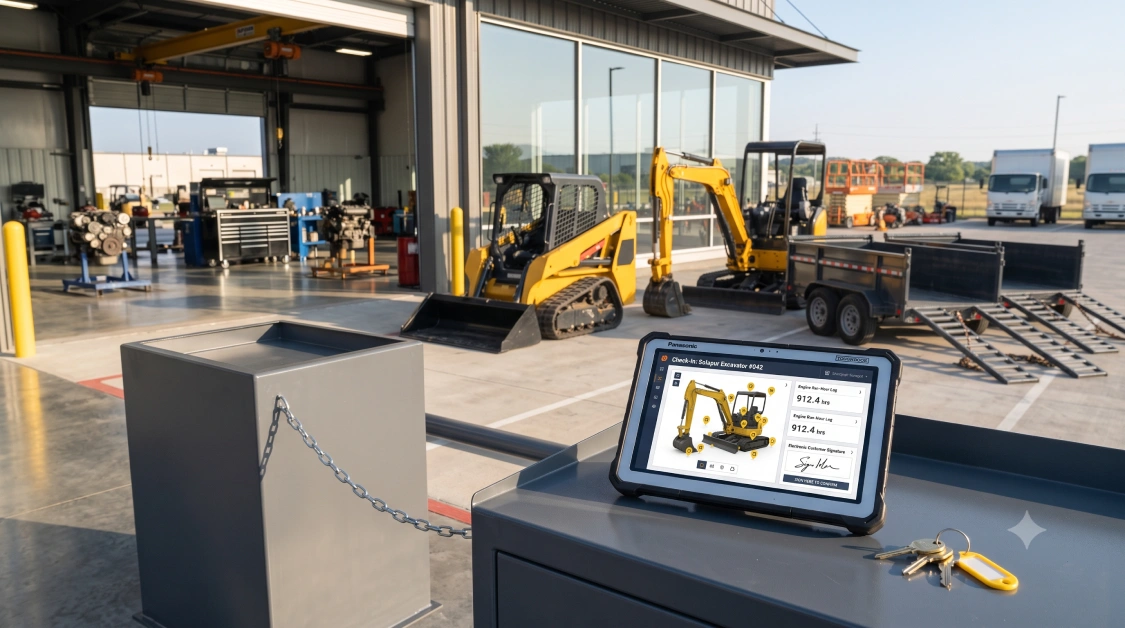
Equipping your yard crew with mobile tablets stops damage arguments by capturing timestamped condition photos, fuel readings, and hour-meter logs right beside the machine during check-out and return. When equipment rolls back into your yard caked in mud, paper-based inspection sheets usually lead to finger-pointing. If your crew discovers a cracked cab window or a gouged hydraulic cylinder hours after the contractor drove away, trying to collect repair fees becomes an uphill battle that ruins customer goodwill.
Moving your check-in routines to mobile devices transforms your yard workflow:
- Clear Proof of Condition: Taking timestamped photos of machine panels, tracks, and buckets during pickup and drop-off creates an undeniable visual record that protects both your business and the contractor.
- Capturing Unbilled Fuel and Overtime Hours: Mobile inspection screens log exact fuel levels and hour meter counts, letting your counter system bill overtime hours and fuel charges automatically.
- Digital Jobsite Sign-Offs: Transport drivers and yard foremen can collect customer signatures right on a tablet screen at the jobsite, confirming equipment arrived in safe, working condition.
The bottom line for your budget is that mobile inspection audits eliminate the awkward confrontations that strain client relationships while ensuring your yard collects every dollar owed for damage and fuel.
How Direct Accounting Integration Prevents Costly Invoice Leakage
Hooking your counter transactions directly to your general ledger keeps revenue from slipping through the cracks by making sure overtime hours, fuel charges, and repair fees land accurately on the final bill. When staff write paper tickets or use disconnected registers, forgotten delivery miles and parts receipts get lost in the shuffle and never get billed to the customer. That administrative lag delays customer deposit releases, causes billing mistakes, and leaves business owners with an inaccurate picture of weekly cash flow.
Connecting your daily counter contracts with native QuickBooks rental software integration protects your back office in three practical ways:
- Instant Invoice Synchronization: Finalized rental agreements, delivery fees, and shop repair orders post straight to your chart of accounts without staff re-typing numbers.
- Proper Liability Tracking for Deposits: Pre-authorized credit card deposit holds route cleanly into designated liability accounts so unearned funds never mix with operating income.
- Real-Time Fleet Depreciation Records: Machine purchase costs, capital improvements, and routine parts bills stay linked to specific asset records, giving you an accurate picture of fleet value and tax depreciation.
When your sales counter, mechanic shop, and financial ledgers operate from the exact same live inventory data, billing disputes drop and cash flow stays predictable.
Why integraRental Delivers the Best Platform for Equipment Rental Operations
The platform built by integraRental delivers the best software for running a modern equipment rental company because it unites real-time fleet availability, shop repair work orders, mobile yard check-ins, and direct accounting synchronization into one dependable setup. Basic software alternatives on the market leave massive holes in your daily routine. Platforms like Company 1 offer basic website booking forms with very little control over back-end yard operations, while Company 2 focuses mostly on barcode scanning without the deep mechanic work orders and hauling tools that equipment businesses need to operate smoothly.
integraRental is built specifically for the gritty realities of commercial equipment yards, tool shops, and multi-location operations. The software handles complex serialized fleets, multi-tier pricing schedules, meter-hour overtime calculations, and damage waivers on a single platform. The platform also offers a Bring Your Own AI model, letting owners connect their preferred AI tools directly to help with repair notes and customer messages without paying marked-up third-party software fees.
Bringing in steady contractor bookings is just as important as organizing your yard. Pairing your software with professional equipment rental web design gives you a customized, search engine optimized digital storefront that displays transparent rate tiers and turns online visitors into paying reservations around the clock.
Practical Action Plan to Scale Your Equipment Rental Operations
Scaling your equipment rental operations comes down to auditing your equipment utilization, enforcing firm yard check-in rules, and giving your crew dependable digital tools. You do not need to overhaul your entire company overnight to see results. A practical, step-by-step rollout helps you pick up better margins right away while keeping your daily counter traffic rolling smoothly.
First, audit your existing fleet to identify your top revenue earners and your slowest-moving units. Adjust your rates on high-demand units and consider liquidating aging machines that cost more in maintenance than they bring in on rent.
Second, put firm mobile check-in routines in place. Make sure your yard crew takes walk-around photos of every machine that leaves and returns, checking fluids and logging engine hours every single time.
Third, connect your sales counter, yard lanes, and accounting books into a unified digital platform that automates rate tiers, manages damage waivers, and prevents double bookings.
When you are ready to see how specialized rental software can organize your fleet, eliminate billing leaks, and grow your bottom line, schedule a personalized walk-through by requesting a rental software demo.
Frequently Asked Questions
What are the most profitable machines to buy when starting an equipment rental yard?
Compact track loaders, mini excavators between three and five tons, scissor lifts, and utility dump trailers consistently deliver the highest return on investment because they boast high contractor utilization rates and hold strong resale values across the secondary market.
How do equipment rental companies track and bill for engine hours?
Rental companies track engine runtimes by logging hour meters during mobile check-outs and returns or pulling live telematics data directly into their rental management software, which automatically applies overtime charges whenever contractors exceed daily contract allowances.
What is the one-three-three rule in equipment rental pricing?
The one-three-three rule is a proven pricing structure where the weekly rental rate equals three daily rentals, and the four-week monthly rate equals three weekly rentals, giving long-term commercial customers fair volume discounts while protecting your operational margins.
Why are mobile condition photos essential during equipment check-in?
Mobile condition photos provide an indisputable, timestamped visual record of the machine at the moment of handoff and return, protecting your business from unbilled damage costs while stopping awkward arguments with customers.
Does dedicated equipment rental software connect directly with QuickBooks?
Yes, platforms like integraRental sync directly with QuickBooks Online and QuickBooks Desktop, sending closed rental agreements, customer card payments, deposit holds, and parts invoices straight into your ledger without manual double entry.